Home Blog Page 22

How beyerdynamic Cracked The Code & Formed A Cult Around Quality

The Queen of England, The Beatles & Ninja – how beyerdynamic manages to remain a cultural touchstone after nearly 100 years.

Companies are obsessed with cracking the code on customer loyalty. They call in consultants, create massive marketing budgets, wring their hands, and yell to the heavens, “what do you people want?!”

Funnily enough, the answer is actually pretty simple: people want quality. 

We yearn for electronics that last years rather than months or days. We sift through dozens of brands and products to find one that makes us think wow, they put some real thought into designing this.

If you build it thoughtfully, they will come. Then, they’ll come back and upgrade.

Audio company beyerdynamic is a great long-term case study that proves this model works. Founded in Germany in 1924, they’ve quietly become a darling of the film, sound design, music, and now gaming industries. 

We chatted with Nicole Gregory, one of beyerdynamic’s technical specialists, about how the company achieved its sterling reputation and its recent foray into the world of gaming headphones.


View this post on Instagram


A post shared by beyerdynamic (@beyerdynamic) on

Collecting A Cult Following

Yes, beyerdynamic makes quality electronics. That said, being the oldest active audio company in the world definitely doesn’t hurt their reputation.

Founder Eugene Beyer launched a company that would be responsible for recording The Beatle’s first European tour, micing Queen Elizabeth’s first official visit to Australia, and creating a host of innovations that shepherded us into modern recording.

“We created the first dynamic headphone, the DT 48 in 1937, and then started rolling with our awesomely engineered headphones and microphones,” explained Gregory. “The products speak for themselves, literally with our mics. And now we’re here! The legend lives on just because of the technology behind them.

I think what most contributes to our success is the products that we make. Our team over in Germany, they create and engineer everything themselves.”

In terms of headphones, the beyerdynamic DT 1990 and T1 are Gregory’s current favorites.

“The 1990 is definitely what I’m most proud of… It’s the juiced-up version of our DT 990 which is already an amazing studio headphone. That’s definitely our guy.” She paused and added, “also our flagship, the T1, is the best sounding overall headphone that we have—the audiophile.”

Rebranding beyerdynamic Sound

beyerdynamic’s current CEO, Edgar van Velzen, recently led a massive rebrand of the company. He and his team overhauled everything from their logo to their mission statement.

“His message is that we create sophisticated products for sophisticated people. Which is not [to say] that everyone has to be critical and sophisticated.” Instead, it speaks to the fact that individuals have specific, discerning taste based on their personal needs and experiences.


View this post on Instagram


A post shared by beyerdynamic (@beyerdynamic) on

“We have these awesome products that will fit you and make beyerdynamic yours… we’ve always been there for [our customers] and we will continue to be there… And with these changes, we are looking into other avenues, other markets. We just released some good ANC—active noise-canceling—headphones which are super cool. We have a bunch of new things coming soon.”

Part of that new, broadened reach includes a surprising addition to the beyerdynamic fanbase: professional gamers.

beyerdynamic & Professional Gaming

Gaming graduated from a hobby to a professional sport in a few short years. Young men and women who were once relegated to their parents’ basements now play video games in stadiums for thousands of cheering fans.

For example, in July of 2019, a 16-year-old American named Kyle Giersdorf won $3 million dollars in the first Fortnite World Cup. The competition took place in the U.S.T.A. Billie Jean King National Tennis Center in New York. If that venue sounds familiar, it’s probably because it’s also home to the United States Open.

All this to say, people take gaming very seriously.

Ninja Precision

Richard Tyler Blevins—better known by his online alias Ninja—is one of the most well-known, US-based gamers. As of July 2019, he was the most followed streamer on Twitch.TV with over fourteen million followers and an average of over 50,000 viewers a week (he’s since switched fulltime to Mixer). Additionally, his extensive list of extracurriculars includes reality TV appearances and hosting his own gaming tournament.

Ninja is a celebrity in his own right. As such, he uses the best gear in the biz including the beyerdynamic DT990s.

Beyerdynamic ninja
Courtesy of Wired

“He just started to use them on his own,” Gregory assured us. “The DT 990 has a special kind of tuning that’ll let you hear the high mids which normally, for humans, is pretty muddy in a lot of music…but 990s kind of open that up. It’ll let you hear things that you wouldn’t normally hear in a game like someone moving behind you.”

However, the beyerdynamic DT 990s technically aren’t meant for gaming. In fact, a few eyebrows raised when Ninja chose headphones associated with sound design rather than gaming. So, beyerdynamic adapted.

“We do have a headphone that mimics the 990, but it is specifically for gaming. It’s called the TYGR 300 R. So they’re fully open, but it’s at 32 ohms so you don’t need a headphone amp with this one.”
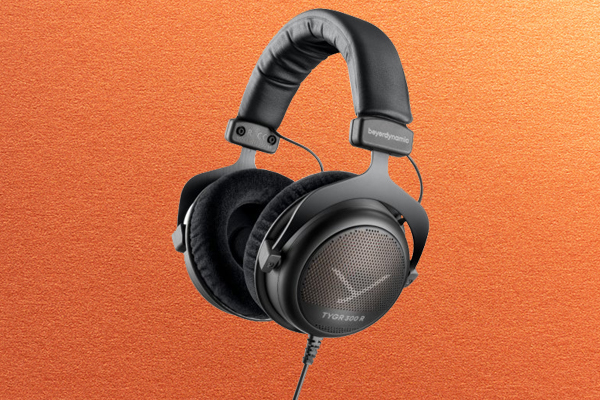
TYGR 300 R Beyerdynamic
TYGR 300 R Gaming Headphones

beyerdynamic is exploring new options for headphones that build on the success of the DT 990s. Currently, their premium gaming headphones are the MMX 300 followed by Custom Game and the fully open TYGR 300 R.

“We are going to be releasing one at a lower price point [that will] mimic the MMX 300,” Gregory said of their expanding gaming models. “But it’s just more friendly, more portable. So we are looking into other avenues of gaming. We definitely want to expand that.”

A Rare Glimpse Into The Rich & Vivid World Of Garry Winogrand

Art museums have a bad reputation. There are now generations of people who associate those imposing halls with angry chaperones, hot school busses, and painfully boring afternoons. After all, you can only force a 6th grader to stare at modern art so many times before they associate it with misery.

No running, no playing, no laughing—museums are too often used as a shock collar to deter fun. Fast forward a decade and those kids are now adults who still associate museums with being shushed into near-fatal boredom.

Admittedly, I was one of those naysayers for many years. It wasn’t until I was an adult living in Brooklyn that I realized museums are more than an opportunity to pelt your friends with plastic giftshop figurines of Degas’ Little Dancer.

Art museums have two defining qualities that kids rarely appreciate. Yet, they’re two of the most valuable, elusive resources that grown-ups in New York City crave: silence and escapism.

All photos are courtesy of The Brooklyn Museum.

Garry Winogrand: Color

The Brooklyn Museum’s photography installation, Garry Winogrand: Color, is just such an escape. It’s a reminder that you can be somewhere else—even someone else—for as long as you’re willing to sit on one of the cushioned benches that line museum hallways.

Winogrand is credited as one of the founding fathers of street photography (along with Roy DeCarava, Gordon Parks, and Diane Arbus). As such, he’s lauded for his black and white photographs of New York City in the 1950s, 60s, and 70s.

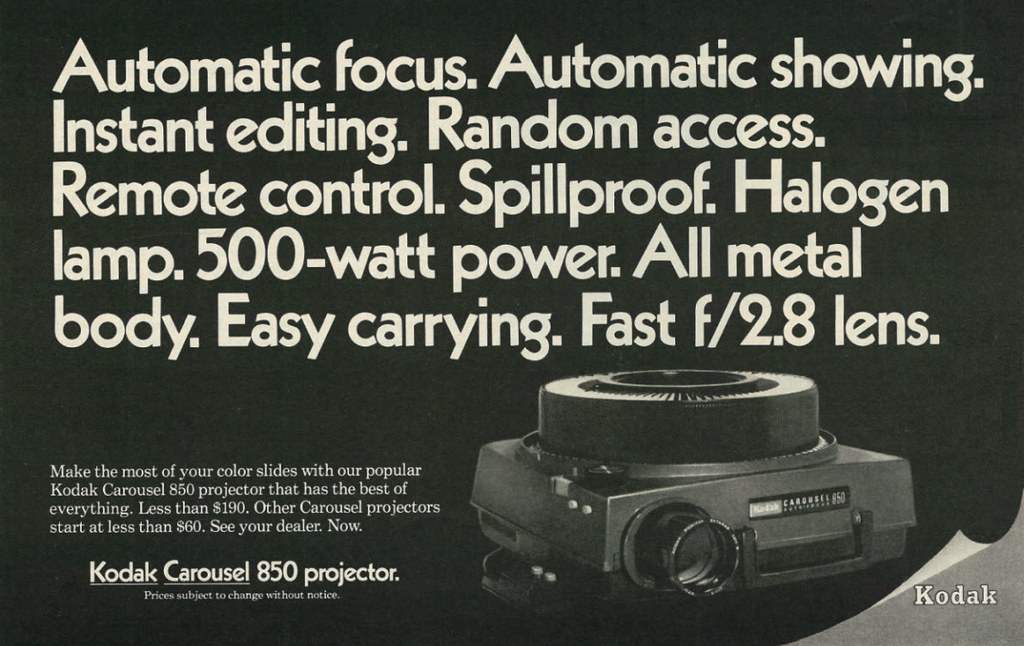
However, the artist also shot in color. He never showed the vast majority of his lesser-known (yet equally beautiful) color photography. Sadly, Winogrand couldn’t afford to create color prints. Instead, he would occasionally show a select few of his vivid shots as a slideshow on a rotating projector.

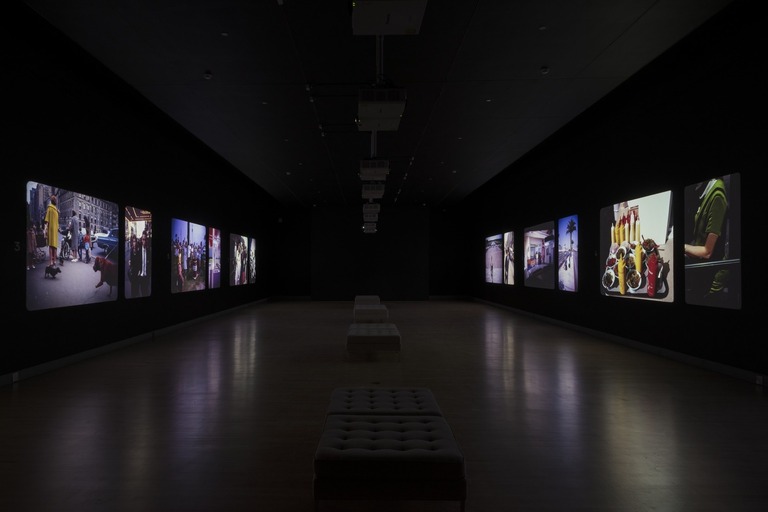
The Brooklyn Museum has recreated Winogrand’s color display on a massive scale.

Courtesy of classic_film via Flickr

The Installation

Garry Winogrand: Color features 450 rarely or never-before-seen color slides sorted into eight sections: Coney Island, Early Color, In The Streets, Portraits and Still Lifes, On The Road, Travel, Women, and White Masculinity.

Each section has a dedicated wall and seating area in the long, dark hallway displaying the artist’s work. Overhead, the low hum and click of the slide projectors act as a soothing, quasi-hypnotic soundtrack.

It’s clear why people love Winogrand’s work. His photos capture a large swath of relatable emotions and microexpressions that characterize the human experience: it’s fun, often painful, and deeply, deeply strange. 

When you add color, Winogrand’s photos become more engaging and infinitely more surreal.

The world the slides portray is hyper-vivid and luminous; it looks like Winogrand painted a fresh coat of shellac on everyone and everything in the frame. Coney Island appears idyllic, clothes look nicer, and food seems more delicious than it has any right to.

It’s enough to make the most hardened cynic look at photos from three of the most politically charged decades in American history and think huh, so there were some nice moments. It also allows the viewer an opportunity to rest in those instants, even if it’s only for the afternoon.

A Curator’s Nightmare, An Art Lover’s Dream

Sadly, cancer cut Winogrand’s life short. He died in 1984 at age 56 leaving behind a wife, two ex-spouses, three children, 45,000 color slides, and about 6,500 rolls of black-and-white film he’d either never developed or never seen as proof prints and contact sheets.

The photographer’s work ethic existed on the fine line between prolific and obsessive. As a result, the curation process for this installation was very difficult. 

Curators at the Brooklyn Museum worked with the Garry Winogrand Archive at the Center for Creative Photography in Tucson, Arizona to review thousands of slides and the few color prints he possessed. It took several years to weigh in the relevant factors and make selections. 

According to the Brooklyn Museum, “in some cases, Winogrand signed, stamped, or marked the cardboard mounts of color slides that interested him. In others, he produced duplicate slides, which are now scattered throughout the hundreds of boxes in his Archive. 

The curators also closely reviewed Winogrand’s black-and-white prints and contact sheets from the same years, looking for overlaps in subject matter, since he often photographed the same subjects or locations with both color and black-and-white film.”

Garry Winogrand: Color is on display at The Brooklyn Museum from now until Sunday, December 8th, 2019. Go escape into his world. Consider leaving your kids with the sitter.

The $14,995 Andy Summers Leica M Monochrom has a matching guitar

We’re camera nerds so (obviously) we love Leica. The problem is, Leica has a habit of releasing specialty cameras that are so spectacularly expensive, the only thing we can do is stare at them in the showroom, drool, and cradle our Leica Q2s. The new Leica M Monochrom ‘Signature’ by Andy Summers is one of those cameras.

This puppy is going for a cool $14,995 and is exclusively available in Leica showrooms—it will be limited to 50 sets worldwide.

But why is this happening?

This project is a three-way collaboration with Leica, Fender, and Andy Summers: former Police guitarist, renaissance man, and avid photographer. Summers has been an incredibly active contributor to the art world for over thirty years. That includes numerous photography books, art installations, and now his very own camera.

Fender created a matching guitar as a nod to the performer’s roots. According to Leica’s press release:

“Mirroring Leica’s dedication to unparalleled craftsmanship, well-known manufacturer of stringed instruments and amplifiers Fender, as well as the Custom Shop, have a long tradition of building signature guitars as a tribute to some of the world’s greatest musicians. Fender is currently launching a special Andy Summers Monochrome Strat® in collaboration with the legendary guitarist.

To honor Summer’s work, and as a complement to the guitar, Leica created the LEICA M MONOCHROM “Signature” by Andy Summers. The limited-edition camera features intricate design elements from the Andy Summers Monochrome Strat, such as a leatherette that matches a collage from Summer’s legendary photo collection that also appears on the guitar and a thin red line engraving running along the side of the entire body.”

 Leica M Monochrom Specs

The camera has the same specs as it’s classic Leica M Monochrom (which runs about $7,950):

  • Sensor: CCD
  • Effective MP: 18MP
  • Sensor Format: 35mm
  • Aspect Ratio: 3:2
  • Image format: JPEG, DNG RAW (compressed or uncompressed), RAW+JPEG

It also includes a Leica Summicron-M f/2 35 ASPH. lens and a Fender guitar-inspired camera strap and an OBERWETH leather black system bag (that $14,995 is slowly making more sense).

The real question is this: if you could, would you buy this camera? Bonus points to anyone who would invest in the matching guitar.

LaCie Rugged SSD & Rugged SSD Pro – Worth The Investment?

LaCie Rugged SSD Featured 2

Once again, LaCie has come into our lives and made them just a little bit easier. The company released several tough new products including the Rugged SSD, Rugged SSD Pro, and a Rugged Mini hard drive. You can check them all out here.

In this post, we take a closer look at the SSD drives, what exactly makes them so tough, and figure out which one is for you.

What is an SSD?

LaCie has an extensive line of hard drives in addition to its growing family of SSDs or “solid state drives.” We went over the basics in our overview of the LaCie Portable SSD. However, it’s worth reviewing again.

Unlike a hard disk drive (HHD), an SSD has no moving parts (hence the name solid state). This is important for a few key reasons. First, the lack of moving parts means that there are fewer elements to be broken or worn down. Second, SSDs are usually faster. And finally, they’re often smaller and quieter.

Rugged SSD Lifestyle Image

Who really needs a LaCie Rugged SSD?

The largest audience for a LaCie Rugged SSD or Rugged SSD Pro consists of on-the-go photographers, videographers, and people who are fanatical about securing their data. The second demographic is made up of highly specialized content creators like sports photographer Liam Doran who does most of his shooting on the side of a mountain; they’re for people who need something portable and hyper-durable.

At A Glance | LaCie Rugged SSD & SSD Pro

Rugged SSD

Rugged SSD Pro

Storage Options:

500 GB, 1 TB, 2 TB

1 TB, 2 TB

Transfer Speeds:

950 MB/s

2800 MB/s

Connectivity:

Thunderbolt 3, USB-C, USB 3.0

Thunderbolt 3, USB-C, USB 3.0

IPX Rating:

IP67

IP67

Drop Tolerance:

3 meters

3 meters

Crush Resistance:

2 tons

2 tons

Dimensions:

.6in x 2.5in x 3.854in

.6in x 2.5in x 3.854in

5-year Rescue Data Recovery:

yes

yes

Similarities

Durability

Both models have an IP67 (or ingress protection) rating. In short, this number indicates that these SSD drives are completely dust-tight and can be submerged underwater at a depth of up to 1m. We created the IPX reference chart below for all the visual learners out there.

The Rugged SSD and SSD Pro both have a 2-ton crush resistance. To give you a bit of perspective, that means a fully grown white rhino can tapdance on your drive and it won’t break. We don’t know why you’d ever have this issue and—quite frankly—it’s none of our business. Just know that you’re covered.

IPX Rating Explained Chart

Connectivity

Most brands go out of their way to make universal connectivity difficult. Luckily, LaCie is trying its best to accommodate the flood of devices currently on the market. Both the Rugged SSD and Rugged SSD Pro have built-in USB-C, Thunderbolt 3, and USB 3.0 ports that support lightning-fast transfer speeds.

Key Difference

Speed

The Rugged SSD supports RAW 4K transfer and editing at up to 950 MB/s. Alternatively, the SSD Pro delivers NVMe-boosted performance of up to 2800 MB/s.

The result is transfer speeds 5× faster than traditional SATA SSDs. Plus, you can play and render high-bit-rate RAW content like 6K, 8K, and slow-motion source files.

Which Lacie Rugged SSD should I get?

Both devices are incredibly fast and facilitate a smooth workflow. However, your choice depends entirely on your plans for this device. Our instinct is always to go with the more advanced model because it’s something you can grow into (in this case, that would be the Pro). However, if you’d rather save the cash and invest it elsewhere, the Rugged SSD is still a solid option.

Fujifilm X-A7 vs X-A5 – Worth the Upgrade? (Comparison Chart & Photos)

fuji-x-a7-blog

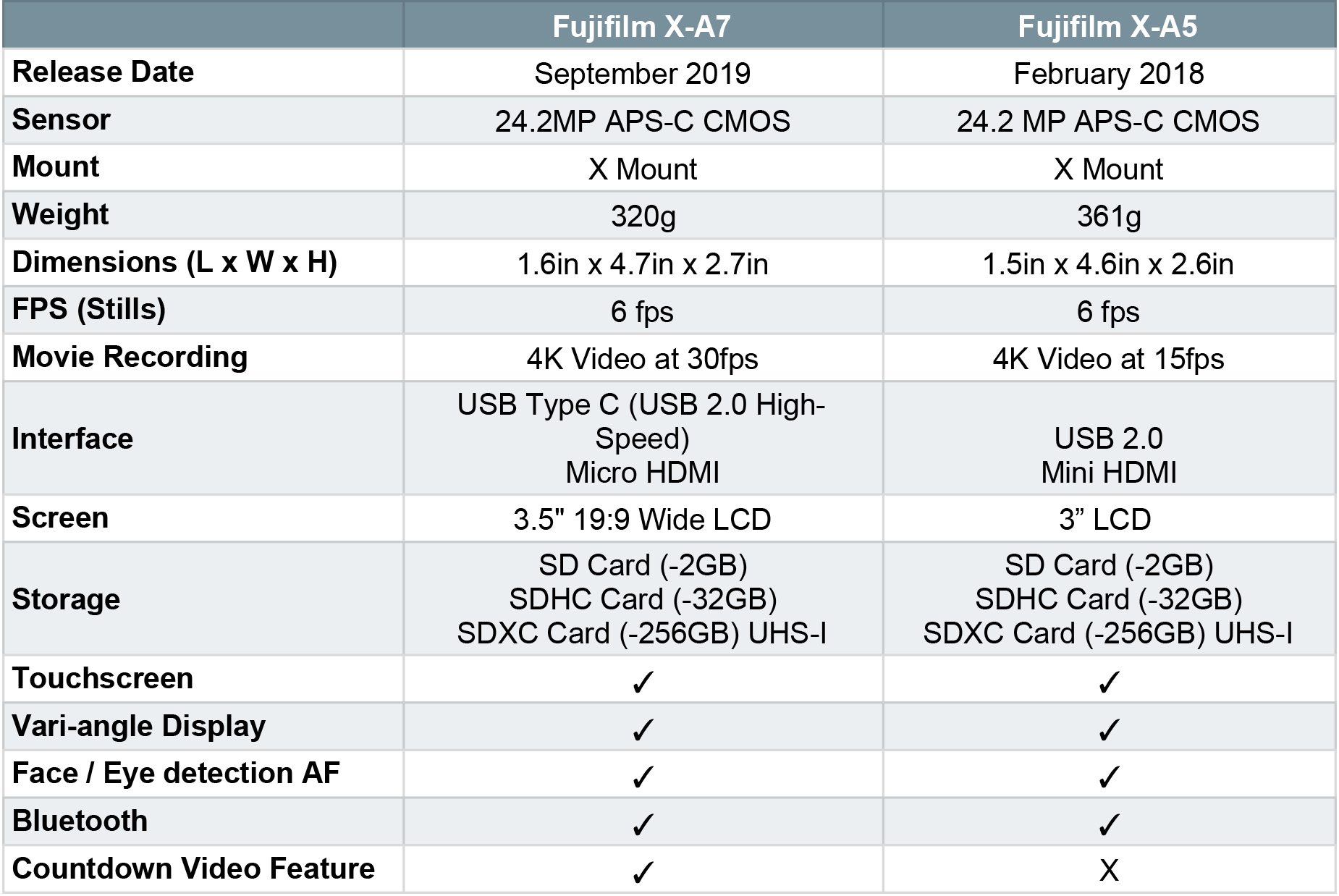
It’s been a year since Fujifilm released the X-A5 mirrorless camera. Today, they officially announced the new Fujifilm X-A7 with updated specs and a new look. Before we jump into features, let’s review specification updates.

Fujifilm X-A7 vs X-A5

Fujifilm X-A7 Comparison Chart

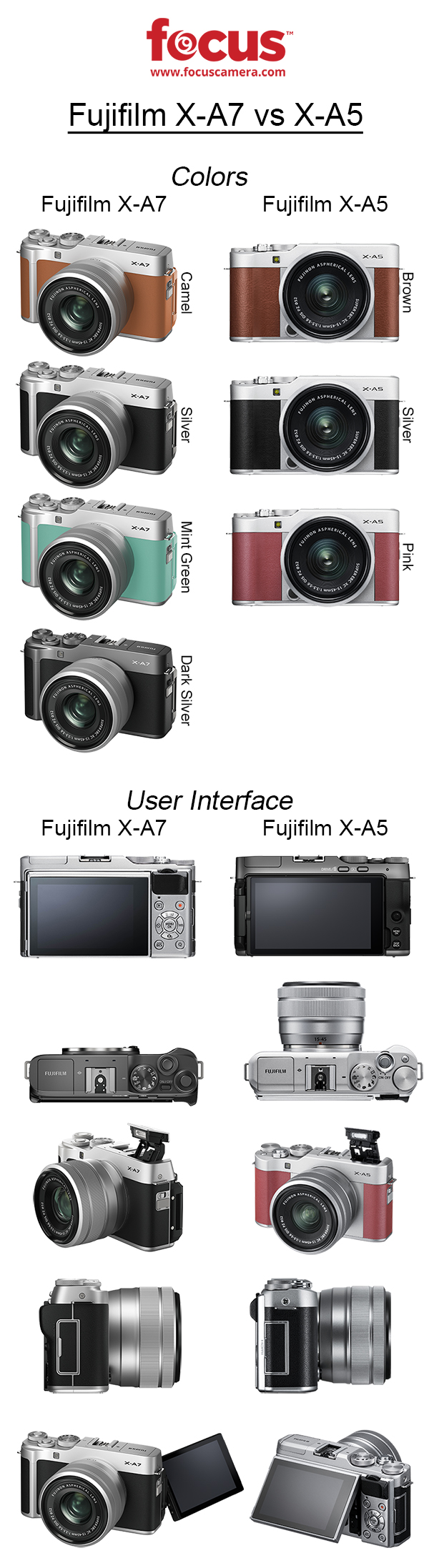
Interface & Body


Fujifilm X-A7 vs X-A5 Comparison Photos

Colors

The most drastic visual update to this model is the change in available colors. The X-A5 was available in brown, pink, and silver. Today, Fujifilm announced an almost entirely new lineup comprised of silver, mint green, dark silver, and camel.

Touchscreen

The X-A7 features a large 3.5” 16:9 touchscreen LCD that’s roughly as bright as most smartphone screens. Like its predecessor, the new model has a vari-angle display that facilitates shooting at any angle. This feature makes the X-A7 especially advantageous for vloggers.

Fujifilm X-A7

Lightweight Design

This might not seem like the most exciting update. But, a little weight makes a big difference when you’re holding a camera all day. It weighs in at a surprisingly light 455g with the kit lens (XC 15-45mm f/3.5-5.6 OIS PZ Lens). This is very impressive when you consider this model’s long-term battery life (440 pictures per charge) and updated screen dimensions.

Video

The Fujifilm X-A7’s 24.2MP sensor shoots 4K footage at 30fps using data equal to 6K (6032×3392). This is a big upgrade from the X-A5’s 15fps. The result is beautiful, high-res footage created in Full HD or HD at a 16:9 aspect ratio or 1:1 for easy Instagram streaming.

Fujifilm X-A7

Shooting Modes

There are also a pair of new shooting modes that you can use on your upgraded X-A7 including a new “Bright Mode” feature that was added to the “Advanced SR Auto” function. In short, this one-touch operation lets your camera automatically configure the ideal settings for HDR and bright, vivid images.

Should You Upgrade?

We definitely recommend upgrading if you use your camera primarily for video footage. However, if you already have the X-A5, it might behoove you to hold off or make a more drastic upgrade.

Over Coffee: Liam Doran on Perfecting Action Photography

Liam Doran Featured 2

Action and lifestyle photographer Liam Doran has the textbook definition of a dream job. He gets paid to travel to breathtaking locations, photograph the world’s elite athletes, and decorate the covers of internationally renowned magazines.

It sounds made up, doesn’t it? It’s the kind of job a rom-com character would have, right alongside magazine editor or globe-trotting food blogger.

On top of it all, Doran’s work has a deceptive aura of effortless grace. Like the athletes he photographs, his precision and ease reflect a combination of natural ability and countless hours spent on the slopes, wading in streams, and scouting outdoor cycling courses.

I chatted with Doran about his career, beginner tips, and gear recommendations in advance of his upcoming skateboarding photography class.

Early Career

Doran purchased his first camera when he was living the “ski shop, ski bum” life and wanted a way to document his adventures on the slopes. He armed himself with a Minolta Maxxum 5 around 2001 and began taking it out with him as often as he could.

“I started shooting for fun and really loved ski photography,” he reflected.

Doran soon felt confident enough to submit photos to Powder, an industry-favorite magazine. The resulting rejection was as swift and heavy as an avalanche; they told him not to bother submitting until he knew what he was doing.

Doran, a man accustomed to taking harsher falls in tougher conditions, got up and kept trying. He invested in a Canon EOS 20D and continued shooting. The switch to digital was a huge turning point—he was no longer restricted to 36 exposures and could review the results of his work in real-time.

He recalibrated and kept submitting to Powder until his work was accepted. 10 years (and dozens of magazine features later), the same outlet that sent Doran his first rejection letter welcomed him on stage to receive the 14th annual Powder Photo of the Year award.

Liam Doran 4
Winner of the 14th annual Powder Photo of the Year award.

Participant First, Photographer Second

I asked Doran if being an avid skier is essential to his work and received an adamant yes.

“You definitely have to be an expert level skier,” he explained. “Otherwise, you can’t get to the spots where you need to shoot.”

He again emphasized the importance of being a participant first and a photographer second when I asked if he has tips for aspiring sport and action photographers (the other two pointers were to shoot constantly and grow a thick skin).

When you eat, sleep, and breath a sport you know how it flows and, thus, the best ways to capture it. You know the angles, the intricacies of the moves, and (in some cases) train with up-and-coming pros.

This advice rings true when you look at many great action and sports photographers. Artist, photographer, skateboarder, and living legend Ed Templeton’s work is inherently tied to his identity as a skateboarder. Similarly, photographer and Oscar-winning videographer Jimmy Chin’s climber’s-eye-view comes from a lifetime of bouldering and top roping.

Doran lives and works in Breckenridge, Colorado where he is surrounded on every side by a wall of nature. As a result, the scope of his work extends well past the world of skiing. 

“I shoot mountain biking, a fair amount of trail running, fly fishing, backpacking, hiking, and also lifestyle and the stories that happen around it,” Doran rattled off. 

Again, and I can not stress this enough, dream job.

Mountain Gear Management

It takes a special kind of dedication (bordering on insanity) to throw yourself off the side of a snowy cliff with nothing but laminated strips of carbon strapped to your boots to guide you. The idea of doing this with thousands of dollars worth of camera equipment strapped to your back would make most photographers faint.

On the other hand, Doran knows that his gear (and his skills) are up to the challenge.

His current camera of choice is the Canon EOS 5D Mark III. Doran is also adamant about exclusively using Sigma lenses to get the crisp, magazine-worthy shots he needs. However, this doesn’t cut it for a full day of mountainside shooting.

Liam Doran 6

A normal shoot includes a BackLight Elite 45L backpack, food, water, skins, a helmet, extra layers, and a shammy or two to wipe off camera elements as necessary.

I was perhaps most interested in how Doran handles after-shoot care. 

On one end of the spectrum, he’s an athlete. Someone who is accustomed to taking hard falls, breaking gear (and bones), and taking practical measures to survive. Alternatively, professional photographers often treat their cameras like a newborn child.

His response fell right in the middle: professional, practical, with an extra edge of mettle.

“If I’m shooting on a storm day, I don’t pull [my camera] out until it’s necessary,” he mused. And when shooting is over? “I just take the camera apart, sensor down, and let everything dry out.”

Participant, meet photographer.

Panasonic Lumix S1H – First Look (Photos, Specs, Pre-Order)

Panasonic Lumix S1H Feature 1

Panasonic has officially announced its latest camera: the Panasonic Lumix S1H. This is the company’s newest addition to its family of full-frame, mirrorless cameras intended for film production.

In addition to its specs (we’re very excited about 6K video), what makes this model notable is its size. Panasonic scaled down a film-production-level camera to a hand-held body that’s small enough to be strapped to a drone or comfortably carried.

Two new lenses were also introduced this week. First, we have the LUMIX G 25mm f/1.4 ASPH Leica lens for the Micro Four Thirds system. Second, released today alongside the S1H, is the LUMIX S Pro 24-70mm f/2.8 L-Mount lens for S Series, full-frame cameras.

Panasonic Lumix S1H | What We Know So Far

Overall Quality

The Lumix S1H houses an incredible quality trifecta: a 24.2MP full-frame MOS sensor, dual native ISO, and a Venus Engine processor. The combination of these elements results in high sensitivity, minimum noise, and cinematic image quality that meets the standards of even the most discerning filmmakers.

The LUMIX S1H also provides 14+ stops of dynamic range and its V-Log/V-Gamut are compatible with a popular colorimetry called the “VariCam Look.”

6K Shooting + Recording Capabilities

The S1H facilitates 6k 10-bit video at 24fps including full-area 3:2 6K24p, C4K (4,096 x 2,160), and anamorphic modes. A few eyebrows have raised regarding this addition, especially among Lumix S1 owners. Why buy this camera when you can shoot 6k with the Lumix S1 V-log upgrade? The short answer is time.

The S1H supports unlimited recording time in all modes including 6K. This is a big upgrade from the 6K time limitations the S1 faces.

The L-Mount System

As mentioned above, the Lumix S1H is a full-frame mirrorless camera that uses the L-Mount system. As of today, there are 46 interchangeable L-Mount compatible lenses available and/or in development. That includes roughly 11 LUMIX S/S PRO lenses available from Panasonic, Leica, and Sigma.

Thanks to a wide variety of Panasonic lenses, third party options, and converters, cinematographers can fully explore the creative potential of the L-Mount system without limitations.

Performance Highlights

Panasonic Lumix S1H 4k HDR4K HDR Video 

HDR modes in HLG format: 4K HEVC (HLG) video mode and Photo Style “Like2100.” On HDR devices, you can view amazing dynamic range and extremely fine gradations of light and dark.  

Panasonic Lumix S1HAnamorphic Recording 

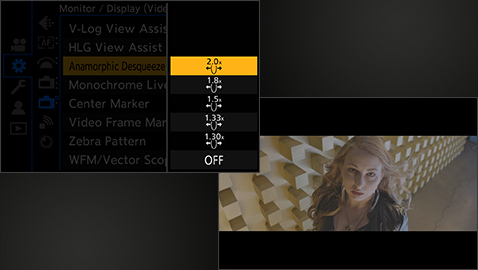
4K 4:3, 6K full-frame 3:2, DCI-4K, and more. Post-production from anamorphic lenses makes Cinemascope possible. An Anamorphic Desqueeze Display function displays Cinemascope-size video at 1.3x, 1.33x, 1.5x, 1.8x, and 2.0x.

Panasonic Lumix S1H 4k VFRVFR (Variable Frame Rate)

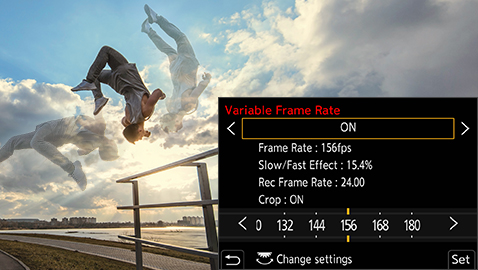
This camera offers support for overcranking and undercranking with access to 2.5x slow in C4K/4K and 7.5x super-slow in FHD. Create emotional slow-motion footage of up to 30x normal speed (30p/2 fps).

System Frequency Panasonic Lumix S1H

HFR (High Frame Rate)

HFR recording is available with audio and autofocus: 119.88p or 47.95p (59.94Hz), 100.00p (50.00Hz), and 48.00p (24.00Hz). Change the frame rate in post-production for slow-motion video.

Panasonic Lumix S1HTime-Lapse Video with 4K 60p/50p

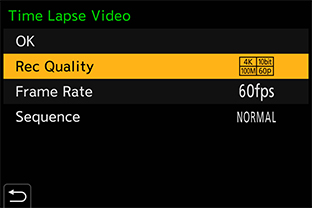
The S1H’s in-body interval capture creates a time-lapse video capable of 4K 60p/50p with smooth exposure transition.

Now, you can shoot photos with V-Log for workflow flexibility or Like709 without color correction later.

Like709 / Knee AdjustmentLike709 / Knee Adjustment

For those in the know, commercial broadcasting consistently utilizes rec.709 gamma curve.

Knee adjustment avoids blown-out highlights, enabling the use of unedited footage in broadcast for quick, efficient post-production work.

Panasonic Lumix S1HVideo Frame Marker

The video frame marker is useful when you’re anticipating vertical/horizontal cropping in post-production edits.

This camera’s displayable aspect ratio frames include 2.39:1, 2.35:1, 1:1, and 4:5; there are 8 total patterns to choose from.

Panasonic Lumix S1HDisplay Modes to Support Videography

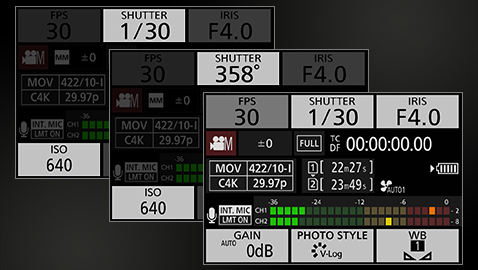
A familiar control panel can be displayed similar to that of a professional cinema camera with 3 display options for Shutter Speed and Gain (Sensitivity): Sec/ISO, Angle/ISO, or Sec/dB.

System Frequency Panasonic Lumix S1H

Choose From 3 System Frequencies

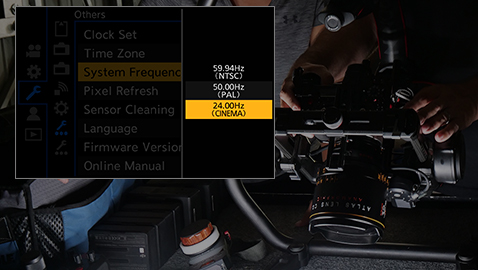
Choose from three different system frequencies to support global video production. Your choices are 59.94Hz (NTSC), 50.00Hz (PAL), or 24.00Hz (CINEMA).

Panasonic Lumix S1H FilteringFiltering / My List of Rec Quality

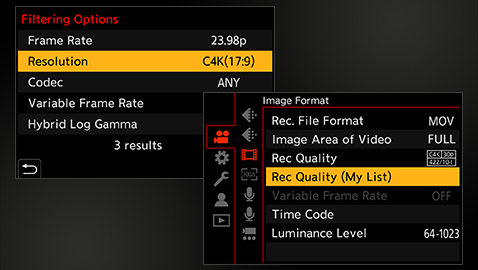
Frame rate, resolution, codec, etc. can be specified and represented in the display. Anamorphic, Variable Frame Rate and High Frame Rate can be displayed. Additionally, “My List” saves frequently used recording modes for quick access.

Panasonic Lumix S1H Segment File RecordingSegment File Recording / Loop Recording

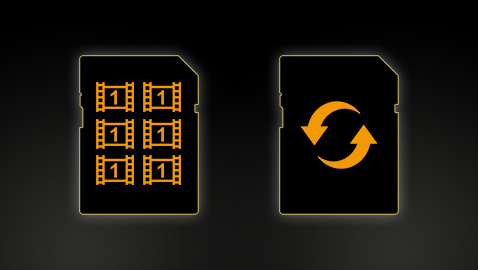
Segment File Recording captures videos as 1-minute segments, preventing the loss of data. Alternatively, Loop Recording deletes old data while recording so you don’t have to worry about capacity. 

This concludes our first look! Keep an eye out for future video reviews and updates on the Panasonic Lumix S1H, LUMIX G 25mm f/1.4, and LUMIX S Pro 24-70mm f/2.8.

The 18 Best Travel Cameras of 2019 – Complete Roundup

Best Travel Cameras 2019

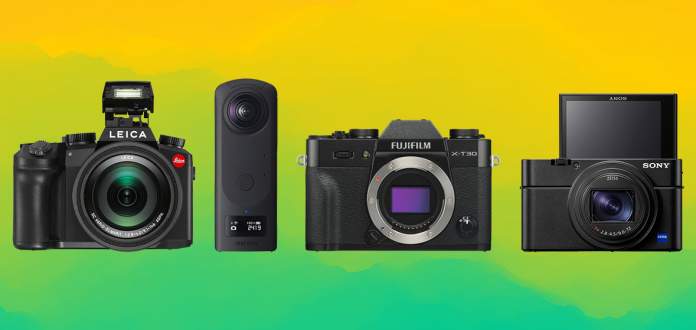
The toughest part of vacation prep is choosing which camera gear is worthy of your carry-on space. We put together this roundup to help you make an informed decision before your next big trip. Below are the best travel cameras of 2019 including point-and-shoots, bridge cameras, interchangeable lens cameras, and action/adventure cams.

With very few exceptions (one or two late December 2018 releases), every one of these devices was released within this calendar year. Scroll down to find the latest and greatest gear and be sure to comment with any questions or additional suggestions.

Point-And-Shoot | Best Travel Cameras 2019

best travel cameras 2019 point and shoot

  • Pros:
    • Point-and-shoot cameras are the lightest option on our list making them a great choice for travel.
    • Their minimal weight goes hand-in-hand with their small size. Point-and-shoots easily fit into pockets, backpacks, and purses.
    • Point-and-shoots are a one-device solution. There’s no need to lug around multiple lenses or accessories in addition to a camera body. 
  • Cons:
    • You are locked into one lens. This limits your ability to get the specific shots you want.
    • A smaller body means a smaller sensor and lower image quality.
    • Point-and-shoots give you a decent amount of control over manual settings. However, you have more control over granular changes with an interchangeable lens camera or some bridge cameras.

Best Travel Cameras 2019 Point-And-Shoot Comparison Chart

1. Sony Cyber-shot RX100 VII

  • Highlights:
    • Optical SteadyShot image stabilization
    • World’s fastest (0.02 sec.) hybrid AF system
    • Retractable XGA OLED Tru-Finder EVF
  • Specs:
    • Sensor: 20.1MP 1″ Exmor RS stacked C, LG instant HDR
    • Image Processor: BIONZ X
    • Video: 4K movie with direct pixel readout and HLG instant HDR
    • Zoom: 8x
    • Screen: Multi-angle LCD
    • Lens: 24-200mm F2.8 – F4.5 ZEISS Vario-Sonnar T* lens

2. Canon PowerShot G7 X Mark III

  • Highlights:
    • Live streaming capable/vertical video support
    • External microphone support, clean HDMI output
    • Selfie-ready tilting screen
  • Specs:
    • Sensor: 20.1MP 1-in stacked CMOS
    • Image Processor: DIGIC 8
    • Video: 4K
    • Zoom: 4.2x
    • Screen: Multi-angle LCD
    • Lens: 24-100mm-equivalent f/1.8-2.8 lens

To learn more about the Canon PowerShot G7 X, check out our guide of the best point-and-shoot cameras of 2019 here.

3. Ricoh GR III

  • Highlights:
    • Shake reduction at slow shutter speeds up to 1/4 second
    • Programmable controls and rearranged keys
    • Fast, precise autofocus
  • Specs:
    • Sensor: 24.23 MP APS-C
    • Image Processor: RICOH GR Engine 6
    • Video: Full HD
    • Zoom: N/A
    • Screen: Fixed LCD
    • Lens: 28mm f/2.8 Lens

To learn more about the Ricoh GR III, read our full review here.

4. Leica Q2 Digital Camera

  • Highlights:
    • Shake reduction at slow shutter speeds up to 1/4 second
    • Compact, fully weather-sealed body
    • Incredibly fast autofocus
  • Specs:
    • Sensor: 47.3 MP Full-Frame Sensor
    • Image Processor: Leica Maestro II
    • Video: 4K with UHD and Cine4K
    • Zoom: N/A
    • Screen: Fixed LCD
    • Lens: Fixed Prime Summilux 28mm f/1.7 ASPH

Interested to see how the original Leica Q stands up to the new Leica Q2? Check out our full comparison here.

Bridge Cameras | Best Travel Cameras 2019

Bridge Group

  • Pros:
    • Like point-and-shoots, bridge cameras are a one-device solution. There’s no need to lug around multiple lenses or accessories in addition to a camera body. 
    • Bridge cameras have consistently strong zoom.
    • You can bring them into most concerts and festivals without issue. Many venues don’t allow people to enter the concert area with “professional” removable-lens cameras.
  • Cons:
    • Bridge cameras’ built-in lenses limit your flexibility and shooting capabilities.
    • They’re bulkier than a point-and-shoot.
    • There’s no room to grow and advance with a bridge camera. It has set capabilities that you must work within.

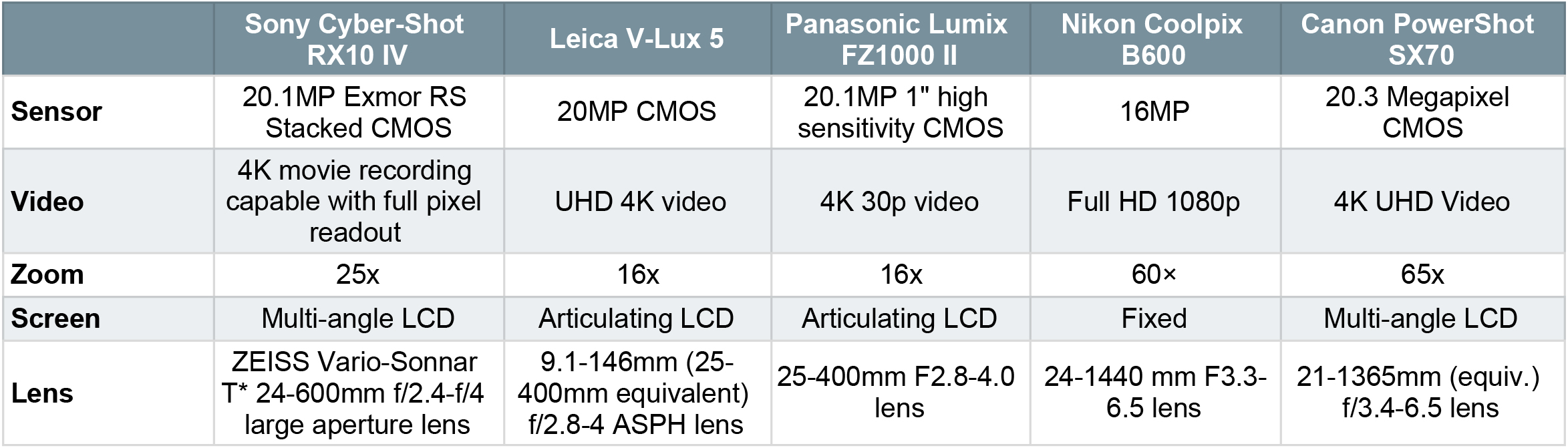
Bridge Cameras Comparison

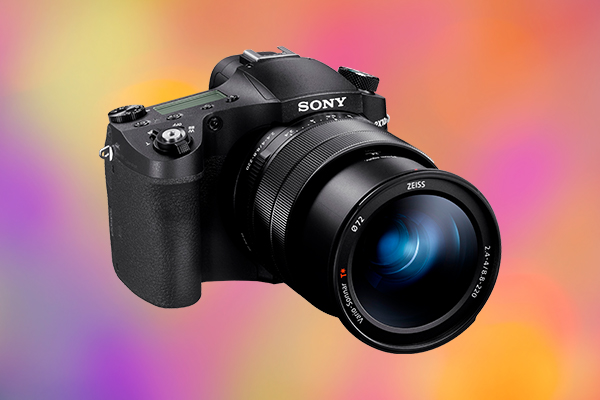
1. Sony Cyber-Shot RX10 IV

  • Highlights:
    • 24 fps continuous shooting with full AF/AE tracking
    • Optical SteadyShot™ image stabilization
    • World’s fastest AF acquisition speed of 0.03 seconds
  • Specs:
    • Sensor: 20.1MP Exmor RS Stacked CMOS
    • Video: 4K movie recording capable with full pixel readout 
    • Zoom: 25x
    • Screen: Multi-angle LCD
    • Lens: ZEISS Vario-Sonnar T* 24-600mm f/2.4-f/4 large aperture lens

2. Leica V-Lux 5

  • Highlights:
    • Post-Focus and Focus Stacking modes
    • Wi-Fi and Bluetooth connectivity with Leica FOTOS
    • Micro-USB battery charging port
  • Specs:
    • Sensor: 20MP CMOS
    • Video: UHD 4K video
    • Zoom: 16x
    • Screen: Articulating LCD
    • Lens: 9.1-146mm (25-400mm equivalent) f/2.8-4 ASPH lens

3. Panasonic Lumix FZ1000 II

  • Highlights:
    • Post Focus and Focus Stacking modes
    • Auto marking and sequence composition functions
    • Approximately 12fps continuous shooting
  • Specs:
    • Sensor: 20.1MP 1″ high sensitivity CMOS
    • Video: 4K 30p video
    • Zoom: 16x
    • Screen: Articulating LCD
    • Lens: 25-400mm F2.8-4.0

Learn more about the FZ1000 II in our detailed comparison post here: Panasonic Lumix FZ1000 II vs Lumix FZ1000 (Comparison Chart)

4. Nikon Coolpix B600

  • Highlights:
    • Superior lens shift vibration reduction
    • Snap-back zoom button to aid in the detection of moving subjects
    • 19 Scene modes
  • Specs:
    • Sensor: 16MP
    • Video: Full HD 1080p
    • Zoom: 60x
    • Screen: Fixed
    • Lens: 24-1440mm F3.3-6.5 lens

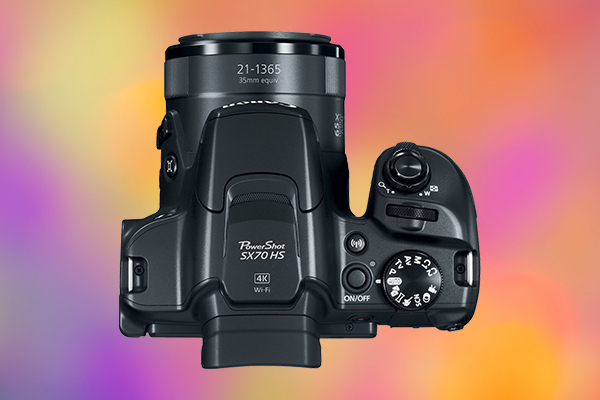
5. Canon PowerShot SX70

  • Highlights:
    • 5-stop Optical Image Stabilization
    • Zoom Framing Assist
    • Continuous Shooting of up to 10 fps
  • Specs:
    • Sensor: 20.3 Megapixel CMOS
    • Video: 4K UHD Video
    • Zoom: 65x
    • Screen: Multi-angle LCD
    • Lens: 21-1365mm (equiv.) f/3.4-6.5 lens

Interchangeable Lens Cameras | Best Travel Cameras 2019

Interchangeable Lens Group

  • Pros:
    • Interchangeable lens cameras are favored by professional photographers. As a result, they provide greater control over granular settings than bridge cameras or point-and-shoots.
    • The option for different lenses and accessories allows you to capture the exact shot you want without compromise. 
    • Interchangeable lens cameras give photographers more room to grow. As you gain confidence behind the camera, you can buy additional lenses or a new, better body. 
  • Cons:
    • More gear means less space. Interchangeable lens cameras and their lenses are bulky and can be difficult to store.
    • You can technically carry one lens. But, if you’re shooting in varied conditions/environments you will need to carry and switch out multiple lenses. Alternatively, bridge cameras are designed to combine the capabilities of 2-3 lenses in one.
    • The body, lenses, and accessories make interchangeable lens cameras significantly more expensive than their counterparts.

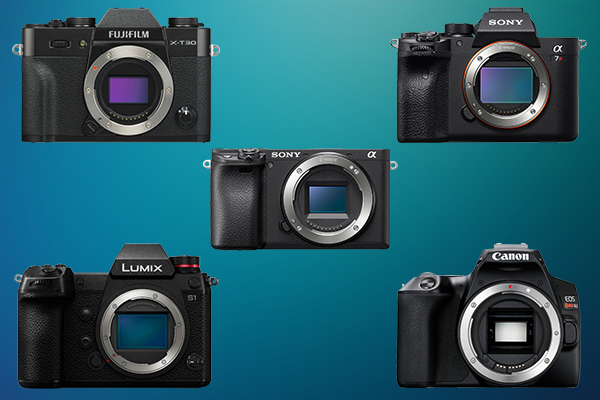
Interchangeable Lens Cameras Spreadsheet

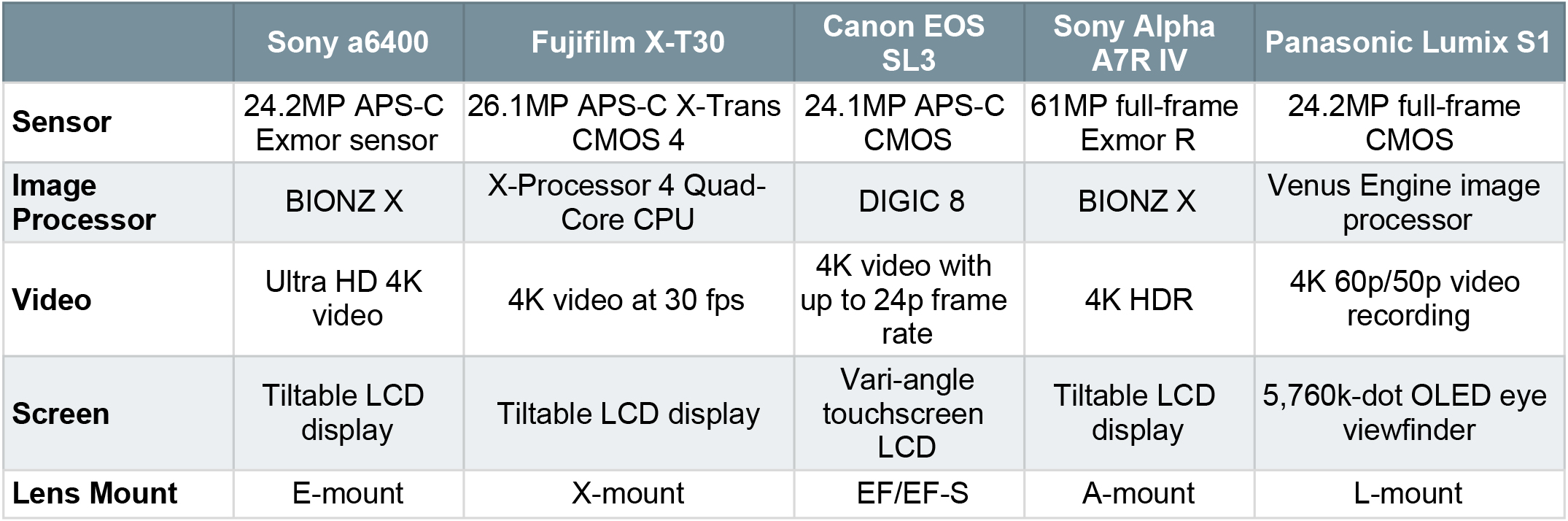
1. Sony Alpha a6400

  • Highlights:
    • 425-point AF
    • Continuous shooting of up to 11 fps
    • Instant sharing via smartphone with Wi-Fi and NFC
  • Specs:
    • Sensor: 24.2MP APS-C Exmor sensor
    • Image Processor: BIONZ X
    • Video: Ultra HD 4K video
    • Screen: Tiltable LCD display
    • Lens Mount: E-mount

Do you need help picking a lens? Check out our roundup of the top 5 best lenses for the Sony a6400 here: The 5 Best Lenses For The Sony a6400 | Sample Photos.

2. Fujifilm X-T30

  • Highlights:
    • Built-in Wi-Fi and Bluetooth 4.2, SD card slot
    • Accurate autofocus tracking and face detection
    • Intuitive design with comfortable controls
  • Specs:
    • Sensor: 26.1MP APS-C X-Trans CMOS 4
    • Image Processor: X-Processor 4 Quad-Core CPU
    • Video: 4K video at 30 fps
    • Screen: Tiltable LCD display
    • Lens Mount: X-mount

3. Canon EOS SL3

  • Highlights:
    • OVF with a 9-point AF system
    • ISO 100-25600
    • 5-axis image stabilization
  • Specs:
    • Sensor: 24.1MP APS-C CMOS
    • Image Processor: DIGIC 8
    • Video: 4K video with up to 24p frame rate
    • Screen: Vari-angle touchscreen LCD
    • Lens Mount: EF/EF-S

4. Sony Alpha a7R IV

  • Highlights:
    • In-body 5-axis image stabilization
    • Up to 10 fps with AF/AE tracking
    • High-speed Wi-Fi / FTP transfer and wireless PC remote
  • Specs:
    • Sensor: 61MP full-frame Exmor R
    • Image Processor: BIONZ X
    • Video: 4K HDR
    • Screen: Tiltable LCD display
    • Lens Mount: A-mount

This camera is the follow up to the popular a7R III. We did a full comparison of both cameras which you can find here: Sony Alpha a7R IV vs a7R III – Specs & Photos (Comparison Chart).

5. Panasonic Lumix S1

  • Highlights:
    • Built-in body image stabilizer
    • Dual SD UHS-II / XQD memory card slots
    • Advanced AF system with DFD technology
  • Specs:
    • Sensor: 24.2MP full-frame CMOS
    • Image Processor: Venus Engine image processor
    • Video: 4K 60p/50p video recording
    • Screen: 5,760k-dot OLED eye viewfinder
    • Lens Mount: L-mount

Check out our full review of the Lumix S1 here: Panasonic Lumix S1 vs S1R (Comparison Chart).

Action Cameras | Best Travel Cameras 2019

These are specialized cameras that fill individual needs. As a result, we can’t give an accurate overview of this group’s pros and cons. Scroll to see the benefits of each model.

Action Camera Group

Action Camera Comparison Chart

1. Olympus Tough TG-6

  • Highlights:
    • This camera is waterproof, crushproof, shockproof, freezeproof and dustproof.
    • It features ultra HD 4K and Full HD 120 fps high-speed video recording for dramatic adventure moments.
    • The Olympus Tough TG-6 has a built-in GPS system, compass, thermometer sensor, and manometer/barometer.
  • Specs
    • Type: rugged adventure camera
    • Sensor: 12 Megapixel BSI CMOS
    • Video: 4K 30p
    • Zoom: 4x
    • Screen: 3-inch, 1040k-dot fixed LCD
    • Lens: Optical zoom lens (25-100mm equivalent), f/2.0-4.9

2. Ricoh Theta Z1

  • Highlights:
    • This is the first Theta camera to support RAW DNG capture.
    • The Z1 features image stabilization.
    • This camera supports 360º HD live streaming.
  • Specs
    • Type: 360° Camera
    • Sensor: Two 1-inch BSI-CMOS sensors, 20mp each
    • Video: 3840 x 1920 @ 29.97fps
    • Zoom: N/A
    • Screen: status monitor
    • Lens: Optical zoom lens (25-100mm equivalent) f/2.0-4.9

We created a comparison chart of every Ricoh Theta camera ever made. You can find it here: Every Ricoh THETA Camera From The M15 to Z1 (Comparison Chart)

3. DJI Osmo Action

  • Highlights:
    • RockSteady stabilization technology
    • Custom exposure settings
    • Waterproof up to 11 meters
    • Dual front-facing and back-facing screens
  • Specs
    • Type: Rugged action camera
    • Sensor: 12MP 1/2.3” sensor
    • Video: 4K videos up to 24fps
    • Zoom: N/A
    • Screen: switchable, dual-LCD screens
    • Lens: 145° field of view, f/2.8

4. DJI Osmo Pocket

  • Highlights:
    • Lossless mechanical stabilization
    • DJI’s smallest 3-axis mechanical handheld gimbal
    • Multiple shooting modes including Motion Lapse, NightShot, ActiveTrack, and 3×3 Panorama
  • Specs
    • Type: pocket gimbal
    • Sensor: 12 MP 1/2.3-inch sensor
    • Video: 4K/60fps video at 100 Mbps
    • Zoom: N/A
    • Screen: built-in, fixed touchscreen
    • Lens: 80° FOV, f/2.0

You can find our first look at the DJI Osmo Pocket here: First Look: The DJI OSMO Pocket Camera

That concludes our roundup of the 18 Best Travel Cameras of 2019. Leave questions and suggestions in the comments below.

Best Portrait Prime Focal Length: Sigma 85mm vs 105mm vs 135mm

Picking a portrait prime lens can be a daunting task and there really is no right answer; it depends on the situation and your preference as a photographer. However, whatever you pick, you have to own it. Literally. In this post, we help you choose the portrait prime focal length that’s right for you.

Sigma 85mm f/1.4 DG HSM Art Lens

  • Focal Length: 85mm
  • Aperture Range: f/1.4 – f/16
  • Price: $1,079.00
  • Mounts: Canon EF, Nikon F, Sigma SA, Sony E

The 85mm f/1.4 is easily the most popular of these 3 focal lengths. But of course, that doesn’t mean it’s best for everyone.

85mm is a great focal length for general portrait photography. It gives you an approximate range of 28.6° which is perfect for full-body shots with a decent amount of bokeh. It’s also great for taking very personal headshots without getting too close to your subject. As a result, this lens is wildly popular with fashion and wedding photographers.

We know everyone loves the coveted 70-200mm for everything from portraits to wildlife photography. That said, we would still choose this 85mm because it’s lightweight and has exceptional low-light performance.

Sigma 105mm f/1.4 DG HSM Art Lens

  • Focal Length: 105mm
  • Aperture Range: f/1.4 – f/16
  • Price: $1,599.00
  • Mounts: Canon EF, Nikon F, Sigma SA, Sony E

This next lens definitely isn’t the lightest in the old camera bag. The Sigma 105mm f/1.4 is for those who are either too lazy to take that one extra step toward their subject or those who enjoy beautiful, swirly bokeh (we’re both).

Weighing in at almost 4 pounds, this lens is so large that it comes with a tripod collar. Honestly, it’s worth the workout.

This 105mm lives in the sweet middle spot of this portrait lens trio.

It’s the perfect lens to pull out when you need its narrower angle of 23.3° and the 85mm just isn’t cutting it. This 105mm is also useful when you want/need to be further away from your subject.

This lens is most popular with wedding photographers because it gives them extreme low-light capabilities and works well for distant headshots. At f/1.4, the background seems to just melt away like a stick of butter on a hot summer day.

Sigma 135mm f/1.8 DG HSM Art Lens

  • Focal Length: 135mm 
  • Aperture Range: f/1.8 – f/16 
  • Price: $1,399.00
  • Mounts: Canon EF, Nikon F, Sigma SA, Sony E

Last but not least we have 135mm f/1.8. No one is ever quite sure why they need this lens until they use it. Then, it’s hard to live without it.

One of the biggest advantages of such a long focal length is this lens’s image compression. Your subjects’ profile will look flatter and bear a greater resemblance to viewing things in real life.

Plus, the 135mm is a great lens for separating your subject from the background and adding depth to your images. It has a narrow angle of view at only 18.2°—it’s hard to miss your shot when everything else is just swirls of bokeh.

If you’re still not sure which portrait prime focal length is right for you…

We recommend checking your Lightroom metadata after your next shoot. Make note of the focal length you use most throughout the shoot. That will help you determine which one is the right choice for you.

Over Coffee: Street Photography With Josh Ethan Johnson

NYC Street Photography Josh Ethan Johnson

Across different mediums, cultures, and through the expanse of time, artists have all struggled to answer the same question: can you capture the sum of a person?

You can certainly recreate their likeness. But—at the risk of sounding like a pretentious art history teacher—can you layer that likeness with hints of the experiences that built them? Or mirror the intangible elements that culminate in the subject standing in front of you?

Luckily for us, photographer Josh Ethan Johnson is attempting to answer those questions with striking results.

A natural empath, Johnson started taking photos of strangers on the city bus as a college student. Nearly 20 years later, he is a remarkably prolific street photographer who has worked with notable names like Vice, HBO, and a24.

Johnson was kind enough to sit down with me and discuss his process, NYC street photography, and the neverending pursuit of authenticity.

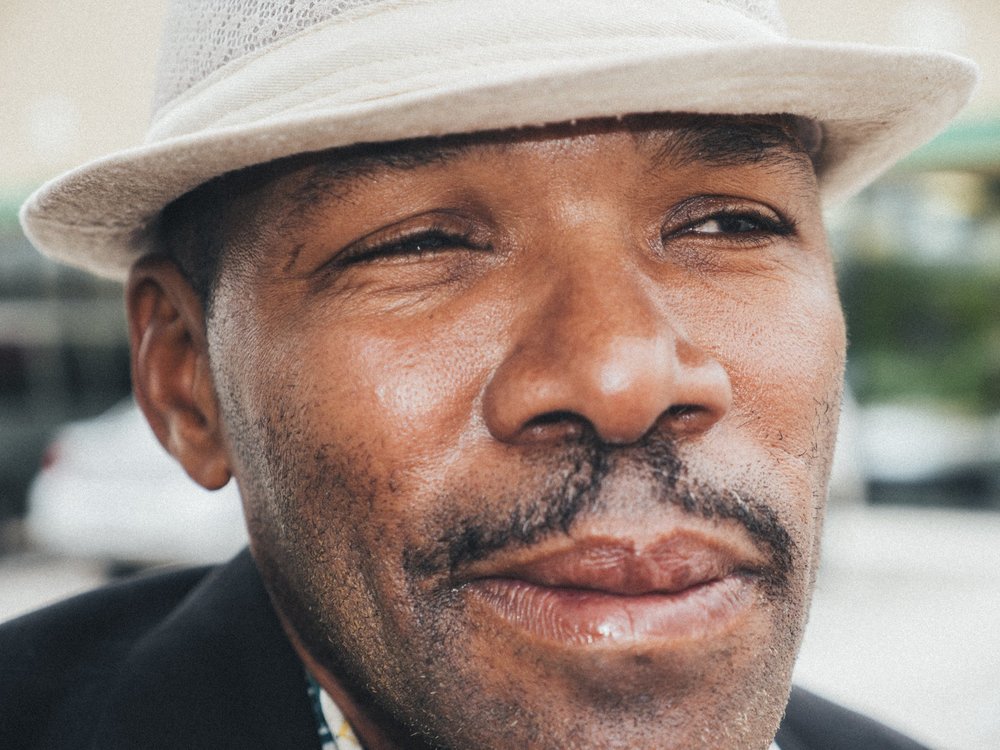
Josh Ethan Johnson Faces
From The ‘Faces’ Collection

The Approach

There’s a voice in every photographer’s head—sometimes whispering, often yelling—that demands they capture a moment. What spurs that need? For Josh Ethan Johnson it’s pure curiosity.

Unlike most street photographers who shoot from the hip and hide in plain sight, Johnson approaches his subjects on crowded New York streets and asks them about their lives.

“The reason I got into photography is because I’m very inquisitive to the point where I want to go up and tap somebody on the shoulder. Why are you here? What’s your relationship with your mother like? I want to discuss how you ended up right here in this time and place. Let’s get into it.”

“And I’m a personable guy. I look disarming… I think,” he glanced at me for affirmation. It’s true, he does. “Some people’s demeanor, some people’s stature, some people’s looks can work for or against them. But I think all of those different attributes that we have, physically or personality-wise, we end up learning how to use those to get the end result we’re looking to get.”

Achieving that envisioned end result is a little easier when you have the right gear. Johnson is the first photographer I’ve ever met who doesn’t hoard an excessive number of cameras. Instead, he utilizes a select few including the Sony RX100 VI, Contax T3, Panasonic GH5, and Sony a7rIII.

Endangered Species Josh Ethan Johnson
From The ‘Endangered Species’ Collection

Nerves Are Contagious

If you’re calm and measured, your subjects are more likely to trust you and match that energy. However, talking to people at random (especially in New York) is still risky. 

I’d wager that the majority of people skittering around midtown are rushed, harried, tired, angry or some combination of those four things. It’s the price we pay for living alongside several million other people. However, if Johnson gets rejected by a subject, he can always disappear back into the crowd and try again. There are endless opportunities for a shot.

His work in New York, while engaging, is preparation for once-in-a-lifetime, one-on-one interactions. 

“It’s harder to walk 100 yards up to a dude alone in a parking lot and then try to disarm them with your personality and start a dialogue…I look at this kind of stuff in New York as practice for the big show, whenever that is. That one moment when I have to really give myself a pep talk and get in the zone and be in the right mind frame.”

Elevation vs. Objectification

Many NYC residents live their day-to-day lives embracing the anonymity that comes with being one face in a crowd of millions. On the other end of the spectrum, there are those who were born to stand out or refuse to fit in; people who aren’t afraid to tout their individuality.

Those in the latter group are usually the ones Johnson wants to politely tap on the shoulder and ask can I take your photo?

Endangered Species Josh Ethan Johnson
From The ‘Endangered Species’ Collection

The trouble is this: there is a fine, vital line between capturing a brief glimpse into the life of another human being and objectifying someone as a spectacle. Regardless of your intention when you snap the photo, you can’t control how an image is received.

“[A photographer’s intention] is defined by the viewer,” Johnson asserted. We discussed Diane Arbus—a photographer who famously documented marginalized groups—as an example. 

“Her provocative images, ‘freak shows’ and things like that, come down to intention. If her intention was to represent a tiny, small fraction of that community and get a dialogue going as a more altruistic motivation, it’s a bit more…let’s say justifiable. Instead of poking fun.”

And when stills won’t do a subject’s story justice? Johnson turns to video.

From The ‘Endangered Species’ Collection

Chasing Happiness

Johnson’s FACES series is composed of both stills and videos that take a deeper dive into the stories of subjects he finds particularly striking. However, his curation isn’t based around tragedy or shock value; he isn’t searching for a soap opera. Oddly, the thing he’s chasing is rarer and more complicated despite its appearance.

Johnson is on the hunt for people who are genuinely happy—not clown happy or temporarily pleased with their situation and hoping for more. He looks for individuals who understand themselves and are pleased with their lives.

He searches the New York streets for them like someone peering through moving water looking for gold. But it’s not enough to find them. Johnson wants to know how they’ve arrived at this peace of mind. What do they do for a living? Who do they interact with? What is their relationship with their mother like?

In these vignettes, Johnson, a restless optimist, spelunks down into the cool, calm world of a satiated optimist. It’s fun to go along for the ride.

Authenticity

Johnson firmly believes that in this, the age of social media, we’re trained to suss out artists’ intentions and authenticity at a rapid pace. For example, Instagram users glean meaning from photos as fast as their finger can propel them down their feed. 

Ever the optimist, Johnson believes that the majority of people can tell genuine, well-intentioned photographers from stock image profiteers.

“We can tell the difference because when [photography is] altruistically driven and not financially driven…there’s just this little extra level of something that you can’t put your finger on.”

“But we, [people] who are interested in this stuff, will spend our lives trying to figure out how to put our finger on that. Because it’s ever-shifting. You have it then,” he threw his hands up like a magician who just made their assistant disappear in a puff of smoke, “it’s gone. It’s fleeting.”

Johnson’s quest to accurately reflect subjects’ humanity is slippery and seemingly never-ending. 

“I took a photo six years ago and I still look at it and think ‘how did I do that? It’s so good.” He paused, a concerned look flashed across his face. “And I’m not patting myself on the back,” he clarified. “I did it. And I can’t even remember how I did it.”

From The ‘Endangered Species’ Collection

On The Wrong Side of The Lens

Roughly a year ago, Johnson kicked off his latest project entitled “The Wrong Side of The Lens.” The series (which has yet to formally premiere) is about lifting the curtain on the artistic process.

Johnson follows photographers around places where they’ve shot in the past and pokes, prods, and provokes them into giving insights into specific photos.

“It’s a conversation about context,” he explained. “[Photographers] have this ability to give or withhold it. I let them decide…if they say, I don’t want to give any context. I say, cool, let’s talk about that. Why? If they want to give context, I say cool let’s talk about that. What’s the context?

From The ‘Endangered Species’ Collection

In actuality, these recordings revolve around a conversation. However, after it leaves the editing room, the videos are 5-30 minute soliloquies of the interviewee. 

“They seem like they’re just riffing and waxing poetic and saying all this interesting stuff because [in real life] we’re having a heated debate and then I just let them go.”

“It’s a test to see how photographers think of themselves and on which side of the lens they fancy themselves. Some people are better in front of the camera, some people are better behind it. A lot of time, I’m finding that people who think they’re terrible in front of it are actually really good and have something to say.”

More From Josh Ethan Johnson