Home Blog Page 36

Who is Gerda Taro, Today’s Google Doodle?

Gerda Taro

On what would have been her 108th birthday, Google honored pioneering war photographer Gerda Taro in its daily doodle. Though she died at just 26, Taro made a name for herself covering the Spanish Civil War. She is considered by many as the first female photojournalist to cover a war, as well as the first to die doing so.

Gerda Taro, born Gerta Pohorylle, escaped Germany in 1933 after being detained for distributing anti-Nazi propaganda. She then went to Paris, where she fell in love with Robert Capa, a Hungarian photojournalist — previously called Andre Friedmann — who taught her photographic technique. The two traveled to Barcelona to cover the Spanish Civil war together as a team when it broke out in 1936. They documented Spanish refugees in Almeria and Mucia, among other aspects of war.Within a year, Capa was famous for his documentation, and Taro began to surface as an independent photographer in her own right. However, a large portion of her work was incorrectly published under Capa’s name. She used a Rollei camera, which rendered square pictures, while Capa used a Leica

That summer, Taro had begun to journey out alone, though Capa warned her to be careful. She covered the Republican offensive solo in Brunete in July 1937, where she was crushed by a Loyalist tank during the retreat. Photographs from that day were never found.

The French Community Party organized her funeral, and she was buried at Père Lachaise Cemetery in Paris. It would have been her 27th birthday.

According to the International Center of Photography, “her pictures are effective portrayals of individuals at war,” and her work conveyed “simplicity and emotional power mak[ing] her small body of work a memorable chronicle of a complex war.” In 2007, ICP exhibited some of her photographs after 4,500 negatives (previously considered lost) from Taro, Capa and photographer David Seymour were found in Mexico City.

The Gold Review: Sony RX100 V

As a compact sensor camera, the Sony RX100 V is ideal for travel or vlogging. It features a 20MP 1″-type stacked BSI-CMOS sensor and 24-70mm equivalent F/1.8-2.8 lens with 4K video capture, a 315-point phase-detection autofocus system, and 24fps burst shooting. We met up with photographer Dan Gold after his European tour through Prague, Amsterdam, Portugal, Estonia, Latvia, and Lithuania to discuss how it tested.

Design and Controls

At 299 grams, the RX100 V is delightfully small and light.  “It was actually my favorite camera to travel with,” says Dan Gold, “because when I’m walking around I constantly shuffle a camera back and forth into my bag.” This gets tiresome, even with a mirrorless. However, the RX100 V is small enough to slide easily in and out of a pocket. “It takes up almost as little room as a phone. If you can carry your phone, then you can carry the RX100.” However, Gold recommends getting a leash to accompany the camera. “There wasn’t really anything to grip onto like a thumb pad or finger grips, so I ended up feeling a little uncomfortable without a strap.”

The controls, meanwhile, are set up much the same way as other Sony cameras. “The settings might not be on the exact same page,” says Gold, “but if you’re familiar with the Sony menu, a specific setting that you’re looking for is not hard to find. There are no new surprises. Everything is familiar.” If this is your first Sony camera, this means that it’s an easy upgrade to mirrorless since you’ll already understand the system. If it’s your umpteenth Sony, then you know the drill.

Image Quality and ISO

Sony RX100 VThere’s a good amount of detail with its 20.1MP sensor.  “There were no major surprises,” says Gold. “I used it a lot in ideal conditions, like daytime with good sunlight and good cloud coverage. I didn’t push it to extreme limits.” The V is more or less identical to its predecessor when it comes to image quality, and features an ISO of 125-12,800, expandable to 80-12,800. “I wouldn’t necessarily recommend it for nighttime in extreme conditions, but in most cases it does well for general image quality.”

Autofocus

“I had no real major misses in terms of autofocusing,” says Gold. The Sony RX100 V features 315-phase detection points, which do away with hunting and keep up with the 24fps burst speed. “It was one of those things where it works so well that I almost didn’t realize it was there. I never had any issues with trying to focus.” For video, too, the RX100 V performs above and beyond. You can, for example, change the AF Drive Speed to “make a quicker transition to focus on objects that enter into the focus plane.”

It includes autofocus modes in wide, center, flexible spot, expand flexible spot, and lock-on AF. “Most of the Sony cameras offer flexible spot, spot, and wide,” says Gold, who insists that it’s valuable to figure out how the different modes perform. “All the modes work so well that when you want to do something specific, it does exactly what you need it to.” Center spot is a good general mode when you need to rely on autofocus, while flexible spot is better for tripods because “you can change the focus point instead of moving the camera.”

Video

While there is a 5 minute recording limit, the RX100 V nevertheless features 4K video. If you want something longer, then 1080p is still an option. There’s also an improved rolling shutter for 4K. “I was kind of learning video with this camera,” says Gold, who recommends the RX100 V as a B roll or second angle option. “If you need two camera bodies, this would be a good option because of its size.”

Moreover, the RX100 V comes with a built-in Neutral Density filter, “which is extremely valuable. When you shoot 24fps, you can get it to 1/50th past that shutter ratio that you need for video.” (There’s a golden ratio of double the frame rate to shutter speed to maintain the right amount of motion blur in videos.) There is also 960fps shooting, which is super slow motion.  “This camera allows you to shoot in 960, which is like 20x slowmo. If you snap and you slow down, it looks like you slowly graze your fingers together.” There’s also a 240 frame rate option, which is more usable for general slowmo.

Battery Life

The battery life is fairly standard. “With the RX100 V, I didn’t exclusively shoot with it for the entire day,” says Gold. “I would shoot the photos of something here or there. I would shoot videos here and there. It does really well as the second shooter camera.” Again, there weren’t any major surprises. It also charges quickly.

In conclusion, the Sony RX100 V is a great travel, vlogging, and second shooter camera with good image quality for its compact sensor. The autofocus goes above and beyond with 315-phase detection points that eliminate hunting and work well in conjunction with video. The V offers 4K for up to 5 minutes, which, while limiting, is great for clips. Light and small, it’s an easy, go-anywhere option.


Review: Xperia XZ2 Premium, a Phone for Photographers

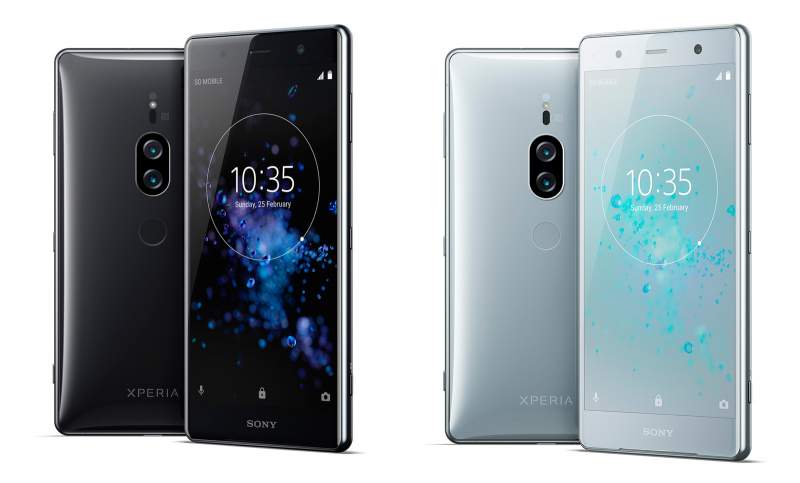
Sony has produced some pretty good phones in the past – even compared to its competitors like Galaxy and Pixel. Yet Sony’s Xperia XZ2 Premium is a particular slam dunk. Seemingly a follow up to the Xperia XZ Premium, the Sony Xperia XZ2 Premium is also an evolution of the flagship XZ2. As a Sony phone, you can expect it to take high quality pictures in all kinds of light. But what exactly makes this phone worth the price?

In terms of design: the Premium is a big, heavy phone with a modern appearance. It’s water-resistant and allows for Qi wireless charging thanks to Gorilla Glass 5 on both sides. While it lacks a headphone jack, the Xperia XZ2 Premium comes with a dedicated camera shutter key and dual front-firing speakers for stereo. There’s also a SIM/microSD card slot that is accessible without any kind of SIM tool. The big selling point, though, is its 5.8-inch 4K (2160 x 3840) HDR Triluminous Display. Colors are rich, and there’s a huge level of detail for gamers, YouTube fanatics, and anyone who appreciates the upgrade from HD. Unlike the popular 18:9 aspect ratio however, Sony went with a 16:9, which can feel a little dated.

Xperia XZ2 Premium

Like Sony cameras, there is a distinct Sony “feel” to the XZ2 Premium in that it replicates previous models with the Android 8.0 Oreo. That said, it’s fast and easy to handle.  It has slightly more RAM than the XZ2 with 6GB, as well as a larger battery – and 64GB of internal storage.  Plus, the Qualcomm Snapdragon 845 SoC is great for gamers thanks to its smooth frame rates.

What you really get with the XZ2 Premium, of course, is the camera. It comes with a dual camera system, an improvement over the Xperia XZ2 single camera. One camera (the main 19MP) records color, and the second 12MP captures monochrome. This secondary picture boosts light when fused with the color image. Hence, the dual-sensor reaches an ISO of 51,200 for stills and 12,800 for videos. The image quality, too, is fantastic. It’s rich on detail, even in low light conditions. Moreover, while it lacks optical image stabilization, the 4K video is superb.  There’s also 960 slowmo in 1080p, which transcends the Samsung Galaxy S9.

While only available on pre-order, the Sony Xperia XZ2 Premium is set to drop on July 30. At $1,000, it costs a pretty penny. For photography enthusiasts, however, it’s worth the upgrade.

Over Coffee: Jeremiah Cumberbatch, Photography Assistant

We met with photographer Jeremiah Cumberbatch for our Over Coffee series at Brooklyn Kolache Co. in Bed-Stuy to discuss growing up in St. Kitts, elegance in photography, and producing music. 

A former music producer, Jeremiah Cumberbatch is now a full time photography student at LaGuardia and a photography assistant for Craige Salmon and Johnny Rosza. “Photography came about when I was producing music,” he says. When he needed a new Broadcast Music Inc. portrait, Cumberbatch called on his brother Alvaro Barrington, then a fine art student, to photograph him. “He’s my older brother. So I figured if he could do it, I could do it. That made my gateway to photography.” Cumberbatch now shoots with a Canon 5D Mark III.

From then on, he took pictures on his lunch break at the recording studio. It was a huge shift. As a producer, he lived and breathed music. “I was in the studio twenty-four seven making beats. It was like tunnel vision, no distractions.” Suddenly, he started taking pictures of people who came into the studio. “Everyone saw me with a camera,” he says. “So I started taking portraits of them, which grew into bigger things.”

Growing up in St. Kitts as one of seven children, Cumberbatch cites his brothers, father, aunt and uncle as inspiration for his artistic and ambitious drives. “My history is a lot. Sometimes I have to reconstruct how I talk about it.” St. Kitts is, after all, an island of 58,000 people, compared to New York’s 8.5 million. He lived there with his mother for the first six years of his life, and then with his aunt and uncle for another six before moving to Brooklyn to be with his father.

“My aunt and uncle are the most elegant people I’ve ever been around,” he says. “I think that a lot of my photography goes back to that.” When he first saw the work of Richard Avedon and Irving Penn, for example, their photographs evoked the same elegance of those formative years. At the same time, he witnessed his aunt and uncle work hard to achieve a comfortable life in St. Kitts. “I tend to go back to everything I learned when I was in St. Kitts,” he says. “I think that’s why I strive so hard.”

photography assistant

His father, meanwhile, owns a business as a driving instructor in Brooklyn. The two didn’t meet until 1993, when Cumberbatch was eight. “My father’s story is the American story,” says Cumberbatch. “Seeing that makes me want to keep going. Even in my times of stress [I think], ‘if my father can do it, I can do it.’” It’s a lot of pressure, but Cumberbatch insists that with equally talented brothers, nobody can fall behind. “Not in this family.”

These days, he’s going back to his production roots. “[Photography] is a lot of energy, definitely. You have to work to get that energy back. Or find an outlet. I’m realizing now that I have to go back to music to be my outlet.” Cumberbatch mixes music on Garageband. Then, he puts it into his phone, and listens to it while he shoots — a cycle of creativity. “[I do] some street photographs, and get some inspiration from it.”

5 cool features of the Panasonic G9

Panasonic just released a new kit with the Leica 12-60mm f/2.8-4 lens. Watch our top 5 features of the Panasonic G9.

New Announcement: Fujifilm XF10

Fujifilm XF10

While it’s not quite a direct upgrade of the X70 that some of us were expecting, the Fujifilm XF10 is a premium compact camera for smartphone users and enthusiasts. Available as Black or Champagne Gold in August at $499.95, it features a generous 24.2 APS-C sensor for its small size (only 280g) and a fixed 18.5mm (28mm-equivalent) f/2.8 prime lens.

Fujifilm promises a “wide dynamic range” in a camera that “produces sharp, high resolution images” thanks to its sensor, along with Fujifilm’s color pre-production technology. Meanwhile, the 19 Advanced Filters like Sepia for retro shots, Rich & Fine for centered bright and vivid colors, and monochrome offer shots with a stylized edge.For Instagram-able pictures, Fujifilm’s new “square mode” is a nice, new bonus. It allows users to flick the screen and toggle a 1:1 aspect ratio. Plus, Bluetooth Low energy support provides automatic image transfer to a smartphone – so you can upload the right sized shots to social ASAP.

When it comes to video, the XF10 shoots 4K – but only at 15fps for approximately 30 minutes. For something less jerky, go for 1080p as an alternative.

In short, this is a good travel camera or a small grab-and-go for an enthusiast photographer or smartphone user.

Over Coffee: Erin Derby, Commercial and Fine Art Photographer

As part of our Over Coffee series, we met with Erin Derby at Parade Cafe to discuss fine art photography, flowers, and a female point of view. 

Erin Derby’s geometric flower photographs made a splash at this year’s NYCFotoworks, a premier portfolio review event in Manhattan. “I have a female point of view,” she says of her stunning, mandala-like creations. “There’s something about flowers that have strong feminine energy. I feel like flowers are bold.”

Armed with only an iPad, Derby stood out among the applicants, both for the quality of her work and partially thanks to a gift from her father. “My iPad was the only thing I brought with me as a portfolio,” she says. “I had this beautiful wood [cover] that my dad had made with a very cool raw edge. That was the thing that everyone immediately responded to.” In her follow up emails, Derby distinguished herself as the one with the homemade wooden holder.

Of course, she inherited more from her father than an intriguing statement piece. As a commercial photographer, Derby’s relationship between corporate and fine art has come to resemble his. “In my dad’s heart and soul, he is an artist,” she says. “In his real life, he was in the corporate world [of industrial design].” Like him, she found a way to balance art for its own sake with the need to make a living. “I wanted to do commercial photography, but of course the dream with photography is to shoot whatever you want and get paid for it.”

Finding Photography

For her, that dream started in high school. “One day I was walking around downtown San Jose for inspiration, and there was a guy on a Harley covered in leather — a total biker.” Derby asked him if she could take his picture. He was initially apprehensive. However, she explained that she was a photography student, and he softened up. “He started asking me what school I went to. I got pictures of him, and he became my friend named Rodney.” When she developed the film, Derby realized that this was her “first good photo.” From then on, she knew wanted to be a photographer. “I thought ‘oh my god.’ It was an epiphany.” Rodney, for his part, kept in touch for years.

Derby later moved to New York after college. She began assisting fashion photographer Sandi Fellman. “It gave me tons of experience in shooting commercial work, still life, and portraiture,” says Derby. Eventually, she was hired as a photographer rather than an assistant, and has worked as one for twenty years.

Fine Art on a Larger Scale

“I’m seeing a use for my fine art in a much wider world,” she says. “For example, I can see it being used in advertising. I can see it being used as the new iPhone photo.” She even retouched a demo picture to show to a potential client in that capacity. At Fotoworks, too, there was a very positive response to her fine art work in a commercial sphere, particularly within health and wellness and beauty.

“I have a million ideas,” she says. “It’s just time to execute.”  While making time for fine art was a challenge in the past, Derby is trying to prioritize it now — Canon 5D Mark III in hand. She often visits the flower market on West 28th for inspiration and to collect subjects. “It’s hard not to buy everything,” she says. However, botanicals aren’t her only focus. “I’m going to start [photographing] snakes from a similar point of view [as the flowers].”  There is a snake sanctuary near her house that Derby aims to utilize. “Usually the way I shoot with flowers, I can’t do the same way with snakes because the snakes are moving. They’re gonna try to get away. I have to figure that out.”

Upgrading to an Interchangeable Lens Camera

So, you learned the basics of focus, framing, and zoom, and you’re ready to switch from point and shoot to an interchangeable lens camera. (There are a lot of advantages to an interchangeable lens camera, not least of all the interchangeable lenses!) While by no means comprehensive, here’s what you need know about interchangeable mirrorless and DSLR cameras as well as lenses before you make the switch.

Interchangeable Bodies

Interchangeable lens bodies accept interchangeable lenses (well, duh – just making sure we’re on the same page). Interchangeable lens cameras have larger sensors than point and shoot cameras, and therefore create higher quality images. There are two types of interchangeable bodies: DSLR and mirrorless.

DSLR

DSLR stands for digital single-lens reflex camera. It reflects the light coming from the lens through a prism (or a series of mirrors) into the optical viewfinder. When you press the shutter, the mirror flips up so that the light passes directly to the sensor instead of the viewfinder.Interchangeable Lens CameraUnlike a point and shoot, DSLRs let you see the picture you’re going to capture without lag. (Point and shoots and mirrorless cameras use sensors that have to transfer that data to a digital display). DSLRs are bigger than point and shoots – and mirrorless cameras, for that matter – because they offer larger sensors with better image quality.  We recommend the Nikon D3400 or Canon EOS Rebel T6 as good starter DSLRs.

Mirrorless

Unlike DSLRs, mirrorless cameras don’t have, well, mirrors. Rather, the sensor is exposed to light all the time, which creates a digital preview of the image on the electronic viewfinder or LCD screen. If you use a point and shoot, then you’re already using a mirrorless camera. However, photographers usually refer to interchangeable lens mirrorless cameras as simply ‘mirrorless.’Interchangeable Lens CameraMirrorless cameras are smaller than DSLRs, but feature the same size sensors, which make them great for travel and street photography. However, some photographers argue that mirrorless cameras have weaker autofocus than their DSLR counterparts, as well as shorter battery life. For mirrorless users just starting out, we recommend the Canon M50 or a Sony a6000.

Interchangeable Lenses

Kit or ‘starter’ lenses come with the camera body. While they’re fine to get started, kit lenses are usually slow with poor image quality. Instead, we recommend picking up one of the following interchangeable lenses to go with your DSLR or mirrorless camera.

Standard

Standard lenses typically range from 35mm to 85mm – i.e. mid-range focal length. They create images that appear natural because they feature an angle of view that is roughly the same as the human eye. They are the most popular type of lens, as they can be used for snapshots, portraits, landscapes, etc.

Telephoto

Telephoto is a long focus lens that brings far objects closer. Unlike a point and shoot zoom, which enlarges portions of the image, a telephoto lens magnifies the image. Typically, telephoto lenses lenses are 100mm and greater. As a rule, the longer the lens, the greater the magnification of the image.Interchangable Lens CameraWide Angle

At 24mm to 35mm, wide angle lenses capture a wider field of view and more of the scene in a single shot.  Landscape and architecture photography often seek wide angle lenses.

Macro

Macro lenses focus from infinity to 1:1 magnification, which means that the image reproduced on the sensor as the same size as the image in real life. Photographers use macro lenses for up close photography.

Taking the jump from a point and shoot to an interchangeable lens camera is no small feat! Choosing between a DSLR and mirrorless, and then picking out your interchangeable lenses, there are quite a few new considerations. We recommend starting with standard lenses before you branch out. Between mirrorless and DSLR, it’s all about what you want. If you want smaller, go with mirrorless. If you’re looking to get started with longer battery life and faster autofocus, DSLR is for you.

Sigma 35mm f/1.4 Art vs NEW Rokinon 35mm f/1.4 AF lens

We compare side-by-side the Sigma 35mm f/1.4 Art lens vs the Rokinon 35mm f/1.4 AF lens in this battle of the fast 35mm lenses.

Light drop off

Sigma 35mm f/1.4 DG HSM ART Lens @ f/16

Sigma 35mm f/1.4 DG HSM ART Lens @ f/11

Sigma 35mm f/1.4 DG HSM ART Lens @ f/8

Sigma 35mm f/1.4 DG HSM ART Lens @ f/5.6


Sigma 35mm f/1.4 DG HSM ART Lens @ f/4

Sigma 35mm f/1.4 DG HSM ART Lens @ f/2.8


Sigma 35mm f/1.4 DG HSM ART Lens @ f/1.8

Sigma 35mm f/1.4 DG HSM ART Lens @ f/1.4

Rokinon 35mm f/1.4 AF FE Aspherical Lens @f/16

Rokinon 35mm f/1.4 AF FE Aspherical Lens @f/11


Rokinon 35mm f/1.4 AF FE Aspherical Lens @f/8

Rokinon 35mm f/1.4 AF FE Aspherical Lens @f/5.6

Rokinon 35mm f/1.4 AF FE Aspherical Lens @f/4

Rokinon 35mm f/1.4 AF FE Aspherical Lens @f/2.8

Rokinon 35mm f/1.4 AF FE Aspherical Lens @f/1.8

Rokinon 35mm f/1.4 AF FE Aspherical Lens @f/1.4

Rokinon 35mm f/1.4 AF FE Aspherical Lens depth of field test

Sigma 35mm f/1.4 DG HSM ART Lens depth of field test


New Announcement: Rokinon AF 85mm F1.4 and the AF 24mm F2.8

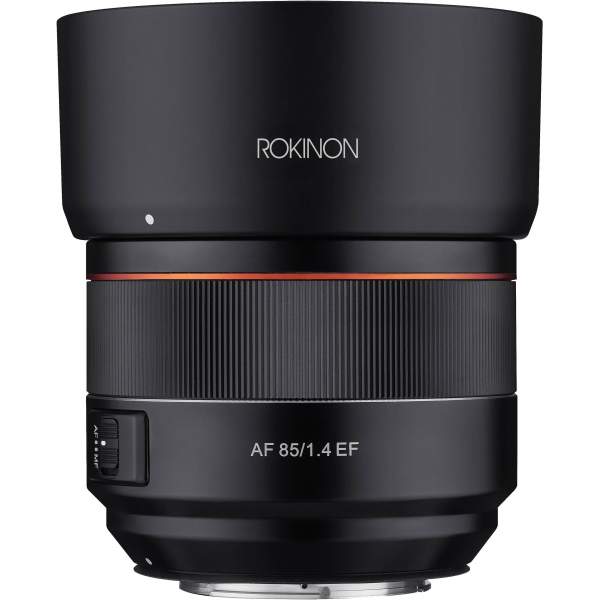
Rokinon recently announced two lenses, the Rokinon AF 85mm F1.4 Full Frame Prime for Canon EF and the Rokinon AF 24mm F2.8 Full Frame Compact Lens for Sony E.

Rokinon AF 85mm F1.4

Vivid, sharp, and bright, the Rokinon AF 85mm F1.4 is made for Canon’s advanced full-frame digital cameras. The design controls distortion, minimizes aberration, and delivers outstanding resolution. Meanwhile, advanced lens technologies create a more compact and lightweight design, at less than 3 inches long and 17 ounces.  The autofocus is fast and quiet thanks to two Linear Ultrasonic Motors that adjust a single inner lens group. Plus, with weather sealing, all metal construction, and an ergonomic design shape, this is an inexpensive lens that doesn’t sacrifice quality or feel cheap. It is currently available for pre-order and is expected to ship in August for $799.

Rokinon AF 85mm F1.4

The Rokinon AF 24mm F2.8 Compact Lens is part of the full frame auto focus lens collection for Sony E mount cameras. “Small in size but big in performance,” according to Rokinon it’s designed to focus on optical quality, portability, and silent autofocus. The lens is composed for 7 elements in 7 groups, and delivers high resolution from the center all the way out to the corners of the image.  With a quiet, fast, and accurate autofocus, as well as inconspicuous size, it’s a great fit for street shooting, video, or travel. For Sony APS-C cameras, including the Sony Alpha a6000/a5000 series, it provides the same features with a wider angle of view at approximately 36mm.  It is currently available for pre-order and is expected to ship some time in July for $399.