A real competitor to one of the best reviewed cameras of 2017 (the Nikon D850), the Sony A7RIII is an all-around great Mirrorless for $100 less. It’s built from the previous A7R’s sensor, but with faster autofocus and ten frames per second shooting. This, paired with great ergonomics and a larger battery, make it worth the upgrade.
With a deeper body, the A7RIII resembles the look of the Sony A9, which should excite users off the bat. The touchscreen and joystick for AP point positioning are both A9 crossovers. However, as this is a Sony camera, there is no flip screen. There is, instead, the Sony custom tilt screen for better maneuverability. In addition, improvements in menu layout are quite nice.
While it can’t compete with the expanded ISO32 of the Nikon D850, the A7RIII extended ISO ranges from 50 to 102,400 (with native 100 to 32,000), and it’s been suggested that the new processing engine should compensate for noise better than the A7RII. Meanwhile, the full frame sensor comes in at 42.2MP, which is very respectable (if not quite the Nikon D850’s 45.7MP). Plus, the sensor is more densely populated than its predecessor, with features like gapless microlenses (to ensure that all light entering the camera ends up in a pixel) and a new anti-flare coating.
The 4K video comes with the option for either full width sensor capture or Super 35mm format (with 4K footage from Super 35 crop oversampled from 5K capture). There are also ports for both microphone and audio to produce all around professional videos. In addition, the A7RIII features Hybrid Log Gamma recording, which is another kind of high dynamic range – also seen in the Panasonic GH5. You can shoot Full HD footage at up to 120fps.
The Sony A7RIII benefits from the release of the A9 while maintaining the best of the Sony A7RII. Like the Nikon D850, it’s one of the most well-rounded cameras on the market. So, if you’re looking for a Mirrorless rather than a DSLR, we certainly recommend it.
Unless you shoot only and exclusively along the earth’s equator, it’s likely you’ll need to learn how to shoot in cold weather. With or without snow, there are a few tricks to consider from keeping your fingers warm to your batteries firing.
Warm, dexterous fingers are the key to a successful cold shoot. They’re also the most challenging thing to regulate. There are lots of photography specific gloves to keep your fingers warm while shooting. However, some simple fingerless gloves (bonus points if they come with the tops to pull on and off) should do the trick.
Acclimatize Your Gear
Don’t jump from warm to freezing! Transitioning too quickly between temperatures causes internal and external condensation, which is bad for your gear. Be sure to acclimatize your camera and accessories by putting them in a bag outside for a while (20 to 30 minutes should do) before they face the bitter cold in full force. When you come inside after a day of cold weather shooting, put your camera in a Ziploc bag (or in a tightly zipped up camera bag) to make sure the warm air won’t hit your glass directly.
Battery Blues
You should always bring spare batteries! Batteries discharge faster in cold weather, so keeping a spare set will spare you the annoyance of dead batteries in the middle of a snowstorm. Store these extra batteries near your body – think under your coat or in your pants pocket – to keep them warm with body heat. Make sure all batteries are fully charged (and double check).
Keep Your Tripod Warm
If you’re shooting with a tripod on a cold day, be sure to insulate it. Cold tripod translates to cold hands and generally uncomfortable shooting. Wrap your tripod in insulation (or honestly, a scarf will do fine).
In the end, just because it’s cold outside doesn’t mean you can’t shoot! Remember to protect your gear, whether it’s with insulation around your tripod or acclimatizing a DSLR and lenses in a camera bag on the stoop. Keep an extra set of batteries warm in your pocket, some fingerless gloves on your hands, and you’re ready to go.
In October of 1998, Doron Gild immigrated from Israel to the bustling island of Manhattan. Only twenty years old, he moved to one of the world’s film capitals to become a cinematographer. After finding the moving picture world too “bitter and tough,” Gild turned his attention to the still picture; a passion he has had since childhood.
“I have that grand, old story,” Gild says. “I had my first camera at six and I bought it myself. It was a small, blue 110 film Kodak.”
As he got older, Gild started taking photography more seriously and his grandparents gave him a proper camera – a Canon T90 – for his Bar Mitzvah. His uncle is the renowned portraitist, Daniel Greene, who painted William Randolph Hearst and Eleanor Roosevelt. With such an early start and an artistic family, it made sense that Gild became a professional photographer, snapping portraits of famous actors, acclaimed artists, noteworthy bartenders, and even other photographers.
“Photography was always there in my life, in one form or another.”
Angela Strassheim / Photo by Doron Gild
Gild started taking classes at the School of Visual Arts, eventually enrolling full time and receiving his MFA. He spent summers working at Mark Seliger’s studio, learning everything he could. “[Working there] changed my life in terms of my knowledge of the industry,” he remembers. In the summer of his Junior year, Gild shot a cover for i-D magazine, a British publication that focuses on youth culture, fashion, and art. While looking at Gild’s own collection of portraits, it’s easy to see what drew him to Seliger’s studio and this magazine. Gild quickly carved his own place within the world of portrait photography.
In 2001, Gild moved to Brooklyn for cheaper rent and the art scene. “It really was the right time to move,” he says. “I moved directly to Williamsburg. It was getting really interesting and nothing was too much yet.”
Karl Franz Williams / Photo by Doron Gild
From there, Gild made it his mission to become a professional photographer. “Whenever I could get my hands on a job, I would do it,” he says. “There was no waiting around. It was something I was actively pursuing. I was always trying to start my career.”
Gild remembers the moment he went from amateur to professional. “When I started making pictures,” he says. “You take pictures and take pictures… Then it becomes a point where you’re thinking about what photographs to take and how to make them. And then all of a sudden, you’re making them as opposed to taking them.”
Aisha Tyler / Photo by Doron Gild
Gild’s portfolio includes Susan Sarandon, Aisha Tyler, and James Patterson. One of his favorite subjects was the famed dancer and actor, Mikhail Baryshnikov.
“He was just such a sweetheart and you wouldn’t know that.” Gild recalls. “He did exactly what I wanted. It took him 3 seconds. It was simple, but he gave me everything. Which is basically how photography works. Your subject gives you something and you have to get it.”
Mikhail Baryshnikov / Photo by Doron Gild
While many of his subjects are impressively big-named, Gild truly enjoys the work he does with everyday people.
“A lot of these people I photograph are big people in their own given industry, but are not A-list celebrities,” Gild explains. “I love being with ordinary human beings and making them feel beautiful, strong, and confident.”
Gild photographs many people in the liquor industry. He shoots famous bartenders, cocktail crafters, and has snapped the portraits for Mehann’s Bartender Manual. His website opens on a picture of Krister Asplund, the VP of Operations at Absolut Vodka. “I am completely attached to that picture, even though it’s not the best picture in that bunch,” Gild says. “But there is so much texture to it. It was a massive turning point in the way I conducted sessions.”
Krister Asplund / Photo by Doron Gild
For Gild, how he takes the photos are just as important as the photos themselves. He first needs to spend time with the model to get to know who they are. Their personalities are a big part of the pictures he takes. “Otherwise, they can’t trust me. I need them to be comfortable but also do as I say. It’s really important to be able to communicate with them, so when I say, “chin up” they know it’s for a reason.”
Gild’s website biography states that he “manages to seamlessly navigate between Art and commercial projects.” While looking at his photos, it is easy to see that he does just that. His portfolio is extensive and impressive, though containing a distinct style. “The way I’m lucky and unlucky is I’ve always been hired to bring my own vision to the table,” he explains. “My own color, my own light, and my own style. Which is my art. When I get paid, I get paid to make my pictures.”
Maxwell Britten / Photo by Doron Gild
However, keeping his own style while shooting for a job is often challenging . “You’ll notice there are not many smiles in my pictures. I’m not the photographer taking pictures of sunsets with people running while smiling. Sometimes I don’t get the job, because of a lot of people want the smiling and the running through fields.” That said, Gild’s style does not necessarily stop a model from smiling. He recalls photographing Masahiro Urushido, a cocktail master whose face naturally grinned during the shoot. For Gild, it needs to be a part of the subject’s personality.
“I like to be honest about things. Fake smiles don’t work.”
Masahiro Urushido / Photo by Doron Gild
Because Gild’s photos are so specific in their style – not to mention the competitive landscape of New York – he is always on the lookout for the next job. Even with an agent and a few regular clients,“the hustle is constant.” Still, Brooklyn is home.
“I can’t think of anywhere I’d rather be,” he says. “It’s been home since the day I moved.”
For Gild, photography is not just a profession, it’s his life. The labor he puts into finding work and making photos is truly a labor of love.
“I really do just enjoy making photographs. All the time, as much as I can. Every time I feel a little down, I know it’s because I haven’t made a photograph in a week. It’s such a necessity, especially since it’s been there my entire life.”
Nikki Jean / Photo by Doron Gild
To see more of Doron Gild’s photography, check out his website here.
Full frame cameras have sensors the same size as a frame of 35mm film. These large sensors yield particularly high resolution images, especially where megapixels are concerned. However, they’re also larger than micro four thirds models, and therefore not as portable. So, is a full frame camera in your future? We outline the advantages and disadvantages of an upgrade.
The first thing to consider with a full frame camera is the crop factor. The reference point for whether or not a digital camera ‘crops’ an image is 35mm film. In the early days of digital cameras, most had smaller sensors than their film counterparts, which shifted the field of view for lenses. Crop factor refers to how much of the image is cropped between a standard (35mm) camera sensor and a smaller digital camera counterpart. As time went on, companies began to build ‘full frame’ lenses that eliminated the crop factor with larger lenses.
Taken with a Canon EOS 500D, crop sensor.
Lens Adaptability
On a related note, one of the best boons for film photographers transitioning to full frame DSLRs is the adaptability of their old lenses. Shooting on full frame cameras will let you maintain your old lenses with the same field of view.
ISO Performance
When we talk about vague terms like ‘image quality,’ it isn’t as helpful as hard specifics. Full frame cameras have better ISO performance than their partial sensor counterparts – like two full stops better in low light. This translates to less noise and clearer pictures.
Taken with Fujifilm X-T1, crop sensor.
Body Size
The big drawback of full frame cameras are there size. Larger sensors mean bigger bodies, and micro four thirds users who are more familiar with smaller machines might not like the jump. A large body means less portability — so you can’t sneak your camera into big events.
While the crop factor is certainly something to consider, it’s not the end all. Lens adaptability and superior ISO are definitely factors, but keep in mind how much of a size jump you want to make. Sticking with a smaller camera in certain cases (especially traveling, or even street photography) may be preferable.
It’s that time again! We’ve compiled some of our favorite photography exhibitions in the New York City area. Whether it’s historical documentary footage, whimsical cyanotypes, or lush color shots, New York has a lot to offer this holiday season. So, if you’re willing to trek through the cold, there’s plenty to see December through March.
The Vietnam War: 1945 – 1975 at New-York Historical Society Museum and Library
October 04, 2017 – April 22, 2018
With interpretive displays, digital media, artwork, artifacts, and documents, in addition to photographs, the New-York Historical Society Museum and Library exhibition on the Vietnam War unpacks the U.S. involvement in Indochina from 1945 to 1975. From the draft and Cold War to the Pentagon Papers, historical footage and thematic analysis invite a diverse and layered conversation about this controversial war.
Modernism on the Ganges: Raghubir Singh Photographs at The Metropolitan Museum of Art
October 11, 2017 – January 2, 2018
Spanning Raghubir Singh’s prolific career from the late 1960s through his death in 1999, this retrospective explores the East-West dichotomy of the artist’s work. Influenced by a traditional Indian aesthetic as well as western artists like Henri Cartier-Bresson and William Gedney, Singh’s distinct style features a handheld camera and color slide film to capture the pulsing opulence of his native India.
Shadowgraphs at Benrubi Gallery
November 30, 2017 – January 20, 2018
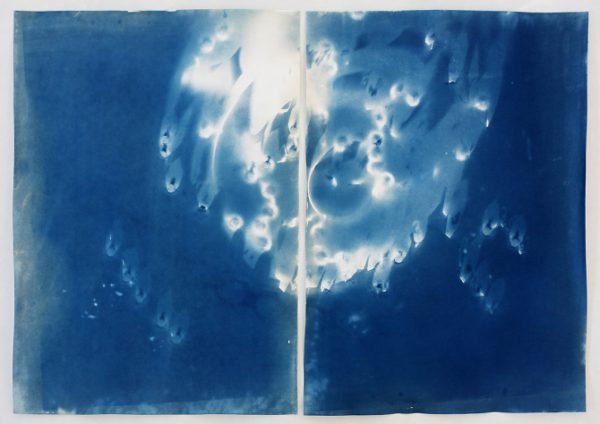
Vanessa Albury’s first solo exhibition features ghostly cyanotypes formed with shapes from a chandelier she bought at a Norwegian junk store. Developed under the midnight summer sun, the images speak to the passage of time in both a literal and metaphorical sense.
Stephen Shore at The Museum of Modern Art
December 4, 2017 – May 28, 2018
“I wanted pictures that felt as natural as speaking,” says Stephen Shore of his latest exhibition, which encompasses five decades worth of work. As one of the most significant American photographers of the last century, Shore’s photographs capture American culture at its most straightforward and unglamorous. From color to black and white to digital, his systematic and often restrained style demonstrates an uncompromising yet casual vision of everyday life.
Whether or not you’re a photographer, photography exhibitions are a great place to recharge your creative batteries. There’s always something new to inspire you in New York, whether it’s at the MET, MoMa or smaller galleries.
“Telephoto” refers to any lens at 100mm and up. Commonly used to capture pictures at a distance, there are two types of telephoto lenses (well, er, lots of types, but one main distinction): fixed vs. zoom. While fixed prime lenses offer better quality, you can’t beat zoom for versatility. We recommend investing in a basic telephoto zoom lens after your first or second standard prime. Something like a 70-200mm zoom functions easily as a “workhorse” lens for anything from sports and wildlife to wedding photography. In addition to outlining the pros and cons to fixed vs. zoom lenses, we’ll also break down which telephoto ranges to consider as you progress.
There’s some confusion about fixed (prime) telephoto lenses. While they don’t zoom back and forth, fixed telephoto lenses still provide intense magnification. They’re often just as (or more so) expensive than zooms, depending on their aperture range. In general, fixed focal length lenses have a wider aperture than a zoom. For example, a fixed telephoto lens with a f/2.8 lets in a lot of light, and is likely to cost a pretty penny. As a rule, fixed telephoto lenses provide sharper images than zooms.
Zoom
Zoom equates versatility. These bad boys take you from distant to right up in your subject’s metaphoric or literal face. With wildlife photography in particular, this is crucial. Telephoto zoom lenses let you keep quiet, and take shots without disturbing your subjects. Zoom lenses with wide, fixed apertures that stay consistent throughout the full focal range offer the most flexibility, as shots otherwise dim during zoom.
Short Telephoto
Short telephoto lenses are barely telephoto. Often zooming from 50 to 105mm, they only just make the cut. Short telephoto lenses capture more more context than their super-zoomy counterparts. In wildlife photography, a small telephoto (whether it’s prime or zoom) gives you more context. It’s not just the animal, but the life of the animal captured. It’s also, obviously, smaller and less tedious to carry around.
106mm
Medium Telephoto
Standard or medium telephoto lenses are some of your workhorse lenses. Great for weddings, something like a 70-200mm lens lets you jump around with the action. Still fairly lightweight, these lenses work well for portraits through distance shots, indoors and out.
188mm
Super Telephoto
Super telephoto lenses jump anywhere from 200 or 300mm to 600 or 800mm. We recommend them for sports and wildlife photography, or just about any situation where you can’t get anywhere near close enough to the subjects on foot. Super telephotos produce close crops of the subject, and their popularity has exploded in recent years. Of course, just wielding a super telephoto behemoth is equal parts luck and skill. It’s a lens where vibration reduction is a necessary investment.
600mm
In general, while telephoto lenses are a dream come true in many ways, they are also more susceptible to camera shake. Some lenses come with a vibration reduction mechanism, but a tripod is a welcome addition to any telephoto. Where zoom provides versatility, fixed is better for sharpness. Short telephotos maintain surroundings in the shot, while standard telephotos are better for portraits at a distance. Super telephoto lenses, meanwhile, take no prisoners, so you should know how to wield a smaller telephoto before you pick one up.
New York City, NY, USA – December 17, 2014: Radio City and Red Holiday Ornament Balls: Red Holiday Ornament Balls located by Radio City Music Hall.
If you’re a photographer, then you already know the implicit eye roll that accompanies any proclamation that you’re “going out shooting [again].” Your friends and family all want to see you this holiday season, but you need to shoot. It’s in your blood! Lucky for you, there are tons of place around New York City to photograph and bring your crew.
Sue us, but it’s a classic. While the lighting took place on November 29, the famous Rockefeller Center tree remains lit and on display until January 7. This year’s tree, a 12-ton Norway spruce, comes by way of State College, Pennsylvania. Photographing at or around Rockefeller Plaza at Christmas time imbues your photographs with a traditional holiday quality – even if you aren’t snapping the tree directly. If you’re lucky, you might even catch a surprise (aren’t they all) proposal out front.
Bryant Park Ice Rink
Whirling dervishes, ballet-like gliders, and people falling flat on their faces – it’s all fair game at the Bryant Park ice rink. For capturing sharp, well-exposed images, we recommend shooting with a tripod. Shoot with flash or during the day for more flexibility and super sharp shots. Of course, slow shutter speed creates motion blur if you want more atmospheric images, while panning (we recommend a monopod for this) smooths that background while keeping the subject in focus. Remember to bring a zoom lens!
Dyker Heights Lights
Branded by certain members of the community as ‘getting out of hand,’ the Dyker Heights lights are nevertheless a Brooklyn tradition. Reliably the most excessive Christmas lights anywhere, 100,000 people flock to this southwest neighborhood each year to see houses positively caked with lights and lawns covered with inflatable snowmen. Shooting lights at night requires ramping up your ISO, as well as a small tripod to safeguard against camera shake.
Holiday Window Displays
From Macy’s and Bloomingdale’s to Saks Fifth Avenue, holiday window displays are worth a second look. These glittering exhibitions, often planned 12 months in advance, showcase whimsical scenes and impressive vignettes. While photographing still life subjects isn’t every photographer’s cup of tea, these incredibly detailed displays are lovely to capture for posterity. We recommend using the same imaging techniques for holiday lights (high ISO, tripod, warm batteries) here.
Union Square Holiday Market
The Union Square Holiday Market is a buzzing seasonal spectacle of internal renown. Great for street photography and capturing general ambiance, this destination features unique gifts from local craftsmen. Bring along a small-ish camera (a Mirrorless rather than a DSLR, if you have one) to slip easily through crowds, and a 35mm prime lens for versatility outdoors.
Sledding in Public Parks
Central Park and Prospect Park in Brooklyn are both classics, but any public park in the greater New York City area will do! Tackling snow photography takes a bit of know-how. You can avoid white out with exposure compensation by manually altering your meter. Try +1 EV for slightly overcast snow, and +2 or even +3 for sunny days with snow. If you don’t already, make sure to shoot in RAW rather than JPEG. While RAW files are a lot bigger, they provide more flexibility in post-production. When it comes to fickle snow, any room to edit goes a long away.
Have we convinced you to take your friends and family holiday shooting this year? Whether it’s sledding in public parks or out on the ice rink, you can combine family time with the ever-important photography time. Remember to bring a big coat and keep your batteries warm as you try to capture the magic of these whimsical holiday scenes.
Point and shoots are good gifts for early photographers, but many of them aren’t a whole lot more exciting than your smartphone. The Sony RX100 V, however, features many of the enticements of a small DSLR or Mirrorless, but without the complications of lens variability. The large sensor captures better dynamic range than most point and shoots, with results that will put your smartphone to shame.
At 10.5 oz, this super compact camera packs in a lot of useful technology. The high quality Zeiss 24-70mm f/1.8-2.8 equivalent lens is great as a workhorse zoom for casual photography, encompassing wide angles nearly up to classic portraiture. The nice, wide f/1.8 aperture accommodates low light photography. Plus, even with a fixed lens, it manages to boast a 1” sensor with phase detection autofocus for a grand total of 315 points.
The 24fps burst shooting is up from 15 in the RX100 IV. This is a speedy little guy also shoots 4K, which sets it above and beyond most point and shoots in its class – as well as some interchangeable lens cameras. The autofocus system does a great job at keeping subjects in focus during video, especially for a pocket camera. Plus, the extreme slow-motion mode should appeal to newbies used to working with video through apps like Instagram. It’s a lot of fun.
While not a touch screen, the rear display boats 1,228k-dot resolution and tilts for angle accommodation. Moreover, an adaptive brightening mechanism makes it easier to see the LCD on a sunny day. In addition, the admirable ISO range is usable up to 6400, as is often the case with models like this.
With a big sensor meets powerful 4K video, the Sony RX100 V is more than your average pocket camera. As a gift for beginners, it packs as much of a punch as many SLRs, but without the complicated controls of interchangeable lens cameras.
LaCie is already a big hit among photographers. Their Rugged hard drives, in particular, are popular for their ultra-tough exterior. But have you heard of the LaCie big RAID series? From the 2-Bay storage and dock to the 6- and 12- bay desktop units, there are lots of ways reasons for photographers to utilize these systems.
Perhaps the greatest boon of the LaCie big series is its ability to store your artistic life on one place. Computers die, memory cards get misplaced, but the LaCie big series safeguards your photographs and videos in one convenient unit. Transfer from hard drives, memory cards, and other devices to an enormous, reliable data bank. That way, if a client needs a piece of footage – even months later – you know where to find it.
Centralize Ruggeds
First, if you don’t already backup your photographs as you travel, please do! The LaCie Rugged series is lightweight and durable enough to store in a backpack. These hard drives withstand the elements for even the most extreme photographers and videographers. If you’re in an out of the house quickly, you can get multiple Ruggeds to serve per project while on the road. Then, when you get back, centralize your all Ruggeds in a LaCie big RAID Storage unit. The big connects quickly and easily to your home device, so you can work fast and get back to the part you love.
Work Faster
The latest big Thunderbolts help you create a faster post-production workflow. Process RAW footage in a fraction of the time. Thumbnail and preview rendering are much more responsive too, even for big projects with lots of high-definition clips. With the latest Thunderbolt, you can even daisy chain 4K displays or a single 5K display to create your ideal system.
For photographers looking to back up their data, we can’t recommend the LaCie big RAID series enough. Between centralizing your data after shoots, creating a faster workflow, and general peace of mind, there’s nothing better. Plus, with a beautiful, sleek exterior, the LaCie big docks look great on a desk!
You deserve the best. Or maybe you don’t. Who cares? It’s holiday season! Time to cash in all your nice chips and hide the naughty ones behind the couch. If there’s a new Mirrorless you’ve been eyeing or a telephoto lens that’s out of your budget range, put it on your wish list anyway! Dream big this year. If you don’t know where to start, then check out our dream wish list below.
The Nikon D850 is one of those rare cameras that receive miraculously good reviews across the board. (We gave it one, too!) Whether you’re a passionate hobbyist or a professional photographer, the D850 is a great reason to remind your partner or parent that you’re worth at least 3K. Between the Nikon-designed BSI CMOS sensor and the enormous 45.7 megapixels, this is a camera that produces action shots and gallery-sized prints. With a deliciously low ISO, stunning shallow depth of field photography is just a stop away.
Canon EOS 5D Mark IV
If you’re a Canon user, the Canon EOS 5D Mark IV costs about the same as the D850. Designed to mimic its processor, the Mark III, the IV is more ergonomic with Wi-Fi and GPS. The full frame CMOS sensor comes with a more than respectable 30.4 megapixels. Meanwhile, the autofocus and tracking focus keep up with moving subjects, and the Mark IV’s ISO capability pushes upper echelons. Even as high as ISO 25,600, images are usable with minimal noise.
Sony Alpha A9
Ah yes, the fabled A9. It’s exactly as perfect as you’ve heard. Made to suit both wedding and sports photographers, it shoots at 20 frames per second with full autofocus. Its burst speeds are among the best on market. At 4.5K, however, it’s more than just a pretty penny. But the low light performance is to die for (and especially good at collecting light at the corners). Plus, while definitely not waterproof, the A9 boasts dust and moisture resistance that make it a bit more durable.
Sigma Art Lenses
With fast autofocus, high quality optics, and incredible Bokeh, Sigma art lenses are ideal for creating those artsy style photographs. (Let’s be honest, who doesn’t want that?) Plus, Sigma art lenses are expensive, as any good lenses are, but they aren’t trade-your-first-born-to- Rumpelstiltskin expensive. This is a perfectly reasonable gift! Sigma makes lenses with mounts for all major brands (Canon, Nikon, Sony, and Pentax, as well as Sigma) too.
Telephoto Lenses
Telephoto lenses are another expensive purchase. Whether for sports, journalism, or other supernatural zoom purposes, telephoto lenses often cost a pretty penny with premium quality optics. For Canon users, we recommend the Canon EF 70-200mm f/4L IS USM Telephoto Zoom Lens with Image Stabilizer, which features an ultrasonic wave motor to produce quiet, yet high-speed AutoFocus, as well as a built-in mechanism to compensate for camera shake. Nikon users should consider the Nikon AF-S Nikkor 70-200mm f/4G ED VR Telephoto Zoom Lens, which performs beautifully in low light and features stabilization technology of its own. For Sony users, the Sony FE 70-300mm f/4.5-5.6 G OSS E-Mount Telephoto Zoom Lens offers SteadyShot image stabilization along with four aspherical glass elements for state-of-the-art optical design.
Manfrotto Midi Carbon Fiber Tripod
You deserve to move up from an aluminum tripod. At just under a grand, this Carbon Fiber Manfrotto is a classic example of ‘you get what you pay for.’ Versatile, precise, supper supportive, this tripod keeps your equipment secure and looks good doing it. Designed to be lightweight yet lasting, the system protect against the “backlash” effects of lesser tripods. It provides fast height adjustment anywhere from 40cm to 184cm, and holds up to 26 pounds.
Syrp Genie
This Syrp Genie is a beautiful little niche product that completely changes the way you shoot time-lapse videos. Designed to work seamlessly with your DSLR or Mirrorless, it comes with presets for stars, clouds, and more, so you can use it right out of the box. It works in conjunction with other sliders, or up on a tripod — with an easy to use menu. It’s definitely one of those ‘I don’t need this, but I want it accessories,’ which makes it a perfect gift. You can check out our tutorial on using the Syrp Genie here. If you’re more of a visual learner, take a look at our Manhattan Lights video as well.
December is the season of dreams. From next level Mirrorless or DSLR bodies to better lighting for your studio, there’s a lot to wish for. Don’t forget to post this around social media to send a (not so subtle) message to your loved ones! Plus stay tuned for Focus Camera’s “Win Your Wish List” campaign this December.